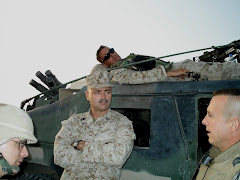
My daughter graduated High School last June and shipped to Basic training on 2 July. As her father I remain pleased with her graduation and applaud her choice to go into the Army in the footsteps of her Father. I know the risks of deployment for her with her unit and accept that she knows I will worry about her no matter what course she takes.
To those that have inquired – she is doing well, having mastered the routine and come to grips with the Drill Sergeants and the regimen. My daughter was a typical American girl – she no doubt misses the mall, TV and freedom for the moment. Her biggest dream at the moment is sleep, some candy (seems that is very restricted in the first couple weeks) and to come home. She comments on how the battle buddy concept works and the team building that goes on. It seems she is being transformed from individual centric into a team member.
She has also noted the development of muscle, strength and endurance… it seems the individual is getting improved as well in a whole spirit and body manner that has to be experienced to be known. She isn’t being brainwashed, I assure you, just accepting that she can maintain some individuality and be a better team member.
Finally there has been an evolving sense of anticipation that she is serving her country. A calling that she heard as a whisper when she signed up, but has come to hear in greater volume since starting down the path as a Army Reserve Soldier. I am still so proud of the service I was privileged to provide and am gratified that the process works to this day to transform young people into soldiers.
Thursday, August 16, 2007


Tuesday, August 07, 2007
Weapons Issue Conspiracy?

The press and conspiracy theorists are all over the GAO issued 31 Jul 2007 report, "DOD Cannot Ensure That U.S.-Funded Equipment Has Reached Iraqi Security Forces,"
The GAO report states:
Although the former MNSTC-I commander reported that about 185,000 AK-47 rifles, 170,000 pistols, 215,000 items of body armor, and 140,000 helmets were issued to Iraqi security forces as of September 2005, the MNSTC-I property books contain records for only about 75,000 AK-47 rifles, 90,000 pistols, 80,000 items of body armor, and 25,000 helmets. Thus, DOD and MNF-I cannot fully account for about 110,000 AK-47 rifles, 80,000 pistols, 135,000 items of body armor, and 115,000 helmets reported as issued to Iraqi forces as of September 22, 2005. Our analysis of the MNSTC-I property book records found that DOD and MNF-I cannot fully account for at least 190,000 weapons reported as issued to Iraqi forces as of September 22, 2005.
Having been part of MNSTC-I in 2004-2005 I can offer the simple assessment of conditions found in the Fall of 2004 when large quantities of equipment were being pushed out to the Iraqi Forces. In that period – MNSTC-I was working in the middle of a war zone with few resources and personnel. We had lots of push to get forces up and operational under overly optimistic thoughts that training and equipping Iraqi forces would enable a quick exit from Iraq. Everything was a clamor to meet numbers demanded by arm chair press and congressional delegations without regard for the actual conditions on the ground.
Against that backdrop – Reserve soldiers thrown into the turmoil toiled night and day to take care of priority one – to issue equipment to all corners of the country. Set up and train the Iraqi Security forces quickly and provide Facilities, equipment, training and mentor the created from scratch organization to take over defense of the country.
Apparently orur J4 section did not always get a legible or “auditable” document from the Iraqi recipients…. Sorry… we did get enough forces equipped to hold elections and start to turn the corner in Iraq… Our tax dollars were not wasted – there is no sensational fraud or corruption…. We didn’t have the luxury of controlled conditions and software systems designed to help. I’m sure the briefed numbers of weapons issued may be slightly off as well – too bad… with the accuracy of 20-20 hindsight we could have attempted to do more… lesson learned… the truth is that this inaccuracy pales to the unaccounted equipment from other wars for this country – the difference now is the hostile press looks for every reason to criticize the effort and holds no account for the difficulty of the task…. Spend a day in the shoes perhaps would serve to cool the rhetoric.
Monday, July 30, 2007
No more access to Blogs
Hearing recently that many DoD employees are being denied capability to open blog sites - more of the Mil Blogging restrictions coming to the Military community unfortunately.
This is a shortsighted myopic design that is likely the result of older generational bias against the tremendous tool that is the internet. Instead of harvesting the energy and opportunity present in the supportive communications from the Military community we have silenced yet more voices to the delight of the Non-DoD and thus criticaly skewed liberal bias.
I can't prove the shutdown, but I fear it is truth to DoD employees....As I have noted here before
Some blogs have stated that this monitoring is somehow a restriction of Blog site freedom of speech… an draconian suppression of the “truth”. I recently experienced the phenomenon with this blog of receiving such monitoring. I will say, there is some intimidation being felt as a mil-bloggers when a military agency “contacts “ the Blog site and offers an alternate point of view or a link to their site. You may have noted the addition of Military sites to several Bloggers lately as they are contacted by such monitoring efforts. The Military establishment efforts are clumsy and becoming increasingly indefensable if an attempt at restricting the reading of opinion - what is next - the shutdown of the opinion page in the Army times?.
I have no doubt that the Defense establishment has likely shut down access to Blog sites as they have acknowledged was done for MySpace, You Tube... It may be done again under the radar of the press this time as a heavy handed local policy or enforcement of the DoD warning that includes a section specifically about blogs.
What is disturbing to me is the sense that opinion, comments on subjective matters such as unit morale, comments regarding the Iraq War in general and other individual opinion topics may be subject to censure. My Fellow Mil-Bloggers all have different views and opinions – the sum of which would paint a pretty accurate picture of soldier and Military oriented public opinion.
We should allow them the right to voice opinion and comment with the caveat that the views expressed are their own on matters of their own choosing when security is not compromised. Commanders should insure that local PAO efforts do not sanitize information within this policy to the point of being the "party line" merely for the sake of conformity to Senior Leadership views. I think we would find that credibility of the Military establishment as a whole will be supported by a free exchange of comment from the soul of its inner workings.
This is a shortsighted myopic design that is likely the result of older generational bias against the tremendous tool that is the internet. Instead of harvesting the energy and opportunity present in the supportive communications from the Military community we have silenced yet more voices to the delight of the Non-DoD and thus criticaly skewed liberal bias.
I can't prove the shutdown, but I fear it is truth to DoD employees....As I have noted here before
Military Blogs are being monitored for content – this should come as no surprise… it makes absolute sense that any entity will monitor information flow, opinion, content and will exploit such information whenever possible. In the current conflict that we face it is a sure bet that US, International and enemy personnel monitor all information sources to include Blogs.
Some blogs have stated that this monitoring is somehow a restriction of Blog site freedom of speech… an draconian suppression of the “truth”. I recently experienced the phenomenon with this blog of receiving such monitoring. I will say, there is some intimidation being felt as a mil-bloggers when a military agency “contacts “ the Blog site and offers an alternate point of view or a link to their site. You may have noted the addition of Military sites to several Bloggers lately as they are contacted by such monitoring efforts. The Military establishment efforts are clumsy and becoming increasingly indefensable if an attempt at restricting the reading of opinion - what is next - the shutdown of the opinion page in the Army times?.
I have no doubt that the Defense establishment has likely shut down access to Blog sites as they have acknowledged was done for MySpace, You Tube... It may be done again under the radar of the press this time as a heavy handed local policy or enforcement of the DoD warning that includes a section specifically about blogs.
What is disturbing to me is the sense that opinion, comments on subjective matters such as unit morale, comments regarding the Iraq War in general and other individual opinion topics may be subject to censure. My Fellow Mil-Bloggers all have different views and opinions – the sum of which would paint a pretty accurate picture of soldier and Military oriented public opinion.
We should allow them the right to voice opinion and comment with the caveat that the views expressed are their own on matters of their own choosing when security is not compromised. Commanders should insure that local PAO efforts do not sanitize information within this policy to the point of being the "party line" merely for the sake of conformity to Senior Leadership views. I think we would find that credibility of the Military establishment as a whole will be supported by a free exchange of comment from the soul of its inner workings.
Monday, July 23, 2007
Homeless Veterans
This last weekend I participated in a Motorcycle poker run which was organized to provide funds for Homeless Veterans. I really did not know the scope if the issue with homeless veterans and always assumed that veterans were a cross section in society and were homeless at the same rate as everyone else.
I decided to read into the issue and found the statistics a little discomforting as a soldier and thought I’d share some with you in the hopes that we all work to never leave a former soldier behind. From the Veteran’s Administration site (http://www1.va.gov/homeless/)
In these statistics one out of every three homeless men has worn a uniform and served this country. The U.S. Interagency Council on Homelessness and the Urban Institute, 1999 provides that roughly 1 in 4 of all homeless people in America are veterans.
As a former soldier these statistics tell me that we have former brothers and sisters that served that need our help. The statistics bear out that we may not be doing enough for some veterans. The VA has some programs to assist veterans, but are they adequate for the surge that will follow the latest war…. I don’t know – at the moment I do a little bit – if all of us veterans did the same I know we would be following the soldier creed – I will never leave a fallen comrade - and perhaps we can make a difference.
I decided to read into the issue and found the statistics a little discomforting as a soldier and thought I’d share some with you in the hopes that we all work to never leave a former soldier behind. From the Veteran’s Administration site (http://www1.va.gov/homeless/)
The U. S. Department of Veterans Affairs (VA) says the nation's homeless veterans are mostly males (4 % are females). The vast majority are single, most come from poor, disadvantaged communities, 45% suffer from mental illness, and half have substance abuse problems. America’s homeless veterans have served in World War II, Korean War, Cold War, Vietnam War, Grenada, Panama, Lebanon, Operation Enduring Freedom (Afghanistan), Operation Iraqi Freedom, or the military’s anti-drug cultivation efforts in South America.
23% of homeless population are veterans
33% of male homeless population are veterans
47% Vietnam Era
17% post Vietnam
15% pre Vietnam
67% served three or more years
33% stationed in war zone
25% have used VA Homeless Services
85% completed high school/GED compared to 56% of non-veterans
89% received Honorable Discharge
79% reside in central cities
16% reside in suburban areas
5% reside in rural areas
76% experience alcohol, drug, or mental health problems
46% white males compared to 34% non-veterans
46% age 45 or older compared to 20% non-veterans
Service needs:
45% help finding job
37% finding housing
In these statistics one out of every three homeless men has worn a uniform and served this country. The U.S. Interagency Council on Homelessness and the Urban Institute, 1999 provides that roughly 1 in 4 of all homeless people in America are veterans.
As a former soldier these statistics tell me that we have former brothers and sisters that served that need our help. The statistics bear out that we may not be doing enough for some veterans. The VA has some programs to assist veterans, but are they adequate for the surge that will follow the latest war…. I don’t know – at the moment I do a little bit – if all of us veterans did the same I know we would be following the soldier creed – I will never leave a fallen comrade - and perhaps we can make a difference.
Tuesday, July 17, 2007
5th Deployment or bust?
If you read the accounts - Army Reserve Sgt. Erik Botta has been sent to Iraq three times and to Afghanistan once and he is going to court because he thinks that's enough.
Sounds pretty daunting for the Army dosen’t it – 5 deployments for this soldier – but wait a minute…. I had to ask how long were the deployments – after all not all are equal in terms of sacrifice…
Botta was deployed to Afghanistan for about seven months in 2002. He then had three deployments to Iraq - about a month in 2003, three months in 2004 and 15 days later that year. That is a grand total of 10 months boots on the ground. Frankly two of the tours to Iraq are about equal to an annual training cycle for reserve soldiers….
Most Army Reserve and National Guard units deploy for 12-15 months consecutively to a combat theater – while I applaud Sgt Botta’s service, he has not done the share that many Reserve and Guard soldiers have in extended deployment. His argument for educational deferment I can see – till the end of the Semester. Many serve as required – with similar issues – it’s a sacrifice to be a soldier – Erik – you haven’t had it all that bad.
"This has nothing to do with protest of the war ... I have nothing but respect for the people on the ground," Botta said Friday, one day after he filed his petition in U.S. District Court in West Palm Beach. "But I feel I do need a fair decision and a fair review." Botta , 26, of Port St. Lucie, contends in his petition that the Army's refusal to exempt him from deployment "constitutes unlawful custody." Botta argues the Army did not consider the length and nature of his previous tours "to assure a sharing of exposure to the hazards of combat."
Sounds pretty daunting for the Army dosen’t it – 5 deployments for this soldier – but wait a minute…. I had to ask how long were the deployments – after all not all are equal in terms of sacrifice…
Botta was deployed to Afghanistan for about seven months in 2002. He then had three deployments to Iraq - about a month in 2003, three months in 2004 and 15 days later that year. That is a grand total of 10 months boots on the ground. Frankly two of the tours to Iraq are about equal to an annual training cycle for reserve soldiers….
Most Army Reserve and National Guard units deploy for 12-15 months consecutively to a combat theater – while I applaud Sgt Botta’s service, he has not done the share that many Reserve and Guard soldiers have in extended deployment. His argument for educational deferment I can see – till the end of the Semester. Many serve as required – with similar issues – it’s a sacrifice to be a soldier – Erik – you haven’t had it all that bad.
Monday, July 09, 2007
The book has come out

In August 2004 I was one of the 98th Division Iroquois soldiers call up to deploy to Iraq as part of MNSTC-I. I went to work with the soldiers mentioned in the book Iroquois Warriors in Iraq published by the Combat Studies Institute Press, Fort Leavenworth, Kansas. The book was put together by Steven Clay. As noted in the forward to the book:
Prior to 2004, a US Army Reserve institutional training division had never deployed overseas to a theater of operations, nor were they designed to function as unit trainers and combat advisors. The author highlights the challenges faced by the 98th Division as it trained for and deployed to Iraq for this unusual mission. Among those challenges were how to train and prepare for the mission, who to send, how to integrate reservists into the new Multi-National Security Transition Command-Iraq (MNSTC-I), and whether to deploy the 98th as a unit or as a collection of individual soldiers.
Throughout the turbulent period of 2004 and 2005 in Iraq, the soldiers of the 98th Division added to the proud legacy of the US Army Reserve. Iroquois Warriors in Iraq tells the story of the history of the 98th Division (IT), it is a compelling narrative of the earliest phases of the Army’s efforts to build the Iraqi armed forces,
Steve did a good job laying out the state of affairs that we as Reserve soldiers faced with the lack of information and a quick deployment to all manner of conditions and challenges. In the book he illustrates several individual 98th Division Soldier’s incredible contributions to the MNSTC-I mission with an honest and frank narrative that pulls no punches. The reading is focused on one Reserve Unit deployment, but provides some insight into the flexibilities and capabilities of a well led organization in a combat theater. I know many of the contributors and their stories are true and really encapsulate the year we spent in country.
Steve provides a fair analysis of the deployment and concludes the book with sound conclusions in chapter 8. He has some great ideas that he floats in this chapter. I particularly like the thoughts on greater infusion of the active and reserve component. As he notes many of today’s senior Active Duty Leadership has more knowledge of the Navy and Airforce as a result of joint assignments that they posess of 2/3rd of the Army in the Reserves and National Guard.
The last note here is the quote attributed to Gen Petraeus
I think they should be justly proud of what they did. In some cases they did missions for which they were completely suited; in other cases, just like everybody else in Iraq, they did missions that were not familiar to them and they responded admirably in each case. . . . To say we couldn’t have done it without . . . the 98th would be a huge understatement, so they ought to look on this episode in their history with pride.12
Yes, I’m proud of the work done by the 98th Division Reserve Soldiers and all those that preceeded and have served since – Thanks to Steve Clay – one story of Reserve Component success has been told.
Monday, July 02, 2007
Mortaritaville - song from Iraq

I heard the song linked here the first time (Mortaritaville) while I was with MNSTC-I in the IZ in fall of 2004 - that song struck a chord with me as a Reservist in Iraq and I have the MP3 file of the song that I pulled off the network over there. We listened to it in our shop and when on the road in thin skinned vehicles...
It was recorded by JR Schultz and Nick Brown a couple National Guard soldiers in the IZ in the fall of 2004 at FOB Warrior. They were with the 1/153 inf from the Arkansas National Guard's 39th Brigade. I asked them permission to share it with a wider audience - As fellow soldiers stationed in Iraq I appreciate the sentiment in the song and I felt compelled to add some of my pictures from Iraq to complete the sentiment. That result can be seen on you tube - Mortaritaville the movie
Their site says
"We started writing songs while serving in Iraq with no predetermined ambitions beyond pleasing family and friends. However, as our music was passed around, we were thrilled to find that everyone seemed to enjoy it. We are not professional singers, songwriters, or musicians. We represent the average soldier serving in Iraq."
These guys just sell these CDs off the web at their site Iraq Songs and don't do any promotion to speak of so it always helps to get a little assistance from those who enjoy the music. They said
"Turns out, sounds like you were one of the first to get your hands on the song, we recorded it in the IZ in the fall of 2004 at FOB Warrior. We were with the 1/153 inf from the Arkansas National Guard's 39th Brigade. I know our music has made it's rounds with e-mail and file sharing and I really think most people would like to know where they could hear the rest of our music. I recently ran into an electrician and after talking to him a while, learned he did some private contract work in Mosul, Iraq in 05-06. Out of curiosity, I asked him if he'd ever heard "Mortaritaville" and he actually had it on his iPod."
As in every conflict - sometimes the songs that come out speak volumes about the truths of service - Motaritaville gives a little bit of what did I get myself into message and reflects that even in the uncertainty of a war zone we can still laugh at ourselves as soldiers... Hats off to these soldiers for sharing with us.
Monday, June 25, 2007
Changes planned for the Reserves
The Defense Department’s service personnel chiefs are presenting insights on better ways to integrate Guard and Reserve members into the total force to the Commission on the National Guard and Reserves. In prepared statements the common theme was a need for the seamless integration of the active and reserve military, civilian employees and support contractors into a cohesive and rapidly tailorable force.
The personnel chiefs' testimony reflected comments offered the previous day by Michael Dominguez, principal deputy undersecretary of defense for personnel and readiness. He urged more flexibility for reserve-component members that enables them to better balance their military and civilian obligations and encourages them to serve. Mr. Dominguez joined the service chiefs in endorsing a "continuum of service" that enables military members to shift between the active and reserve components, more full-time support for Guard and Reserve units, expanded opportunities for joint training and qualifications and a more competitive compensation package.
I have stated in this blog previously that there is a real need for more full-time support to guard and reserve units – having been a part of that structure for 18 years as a military technician. Reserve units are really busy and all critical tasks cannot be accomplished by short handed staffs.
The fact that the services have discussions and seem to be working to fix the gap in the continuum of service for the reserve components is encouraging. I can attest to the bureaucratic tangle required to switch from active Reserve status to active duty caused by everything from TRICARE paperwork to orders to report. I have proposed here as well that an easy transition between Reserve and active component service should be sought as an alternative to current practice to allow a full time part time work schedule as life’s events may require.
What I did not see mentioned is training – the active community has the training resources but they are seldom available to Reserve units on an equal basis. Improve the dynamic of pushing training to Reservists will greatly improve the efficiency of reserve drill periods.
To achieve a balance between military and civilian obligations is perhaps the toughest task facing the commission. Every Reservist is essentially a little at the mercy of civilian employers to hire the reserve soldier or provide support. In reality the enforcement of employer support to the Guard and reserve is not up to the challenge to resolve the hard to prove discriminations which inevitably occur. Additionally – we ask a lot of employers when we take their reserve employees for 2+ years in a 5 year employment cycle – you won’t see that as a recipe for success in any business plan.
Finally – the compensation package – achieving a balance to keep the soldier in uniform as a guard or reserve member. I believe we are doing a passable job now as retention rates seem to be good… but that conveyor has to be fed new soldiers which we are lagging in the Army Reserve.
We do ourselves little positive incentive advertising with deployment rule changes that have changed the conditions of deployment. We make the news with ill advised stop loss policies that hold soldiers past contractual agreements. We must avoid making the Reserve forces career one of deployments on an irregular basis for a changeable period to every need from Homeland defense, emergencies to warfighting. We cannot think that all employers are patriots first and observe the impact of Reservists on the bottom-line second. Reserve and Guard must have some predictability to perform in civilian positions, complete school and serve as well. To keep the best and brightest – those reserve soldiers going somewhere in their civilian lives - we must offer an established path to success in the reserve environment that has the flexibility to compliment civilian and military careers.
Friday, June 22, 2007
It is AT Season

I started waxing poetic the other day when I realized that this time of year was when my last unit had its regularly scheduled Annual Training. I realized that in a circadian rhythm I had always been scheduled for significant events for the summertime period – many annual training cycles, but also my R&R from Iraq, my wedding 25 years ago. I guess this year for the first time I really had nothing planned and I was only jarred into that realization as I passed a convoy of vehicles heading for Ft. Drum for an annual training cycle…that annual summertime event I shared for 18 or so years.
I remember the planning, increased buzz of activity at the Reserve Center that preceded the big day that the Convoy was assembled and set off for the AT location – usually several states away. The ride in Jeeps or later HUMMVs on the interstate and the swelling of chest as cars would pass by the vehicle and waved, cheered, kids with faces pressed forward to see soldiers. The training time would be a flurry of overtasked days to complete every imaginable training task prior to the end of training period. The ride home and the cleaning, repacking and tired satisfaction that came from knowing that once again AT was successful and our skills were re-sharpened.
I have always given the analogy that serving in the Reserves was like Minor League Baseball. Provided older equipment, fewer resources and less pay, the game we played was the same as the Active duties (Major league) – The rules were the same, the playing field was essentially the same – Minor league players may not have had the flair or polish but they understand the fundamentals of the game. Occasionally we would get called up to play in an active duty assignment and all that we had was going to be required when playing on the bigger field.
Today, much of the reserve force has deployed to a bigger event, the amateur feel of Annual Training seems like we were just playing a game when we went to Pickett, Dix, Drum, etc…. But it was the basis for many part time soldiers stepping to the plate when called. Those bucolic summers somehow enabled the thinking green mindset and can do ability for the Reservist that I served with in Iraq. Now I guess I see the annual training event in a different light – I miss the fun and enjoyment of the annual event and know that our efforts really mattered to our country – So when you see those Reserve and Guard soldiers heading for Annual Training – wave and let them know how we appreciate what they are doing.
Wednesday, June 13, 2007
IRR - no more Shell Game
The Associated Press reports that the Army is notifying 5000 Individual Ready Reserve (IRR) soldiers to report to RRC locations for medical screening and administrative tasks. IRR is a category of soldiers that have no remaining active duty or active reserve obligation (paid status) but are awaiting expiration of service – it also is the catch all location for soldiers administratively separated from active reserve units for Physical fitness failure or overweight. IRR soldiers are not putting on uniforms, going to drill, or being administered in any way in the Army as it stands today. Many IRR members are people who were honorably discharged after finishing their active-duty service but have not yet completed the eight-year commitment they made when they joined the Army. Some are former officers who chose not to resign their commission and thus remained on the IRR rolls.
The recall of 5000 IRR soldiers should be viewed as a required repair of the IRR system which has absolutely abandoned and neglected Active and Reserve soldiers assigned to its ranks for the last 5-10 years. The Army Reserve has expended little effort in the recent past to assist IRR soldiers, encourage them to join units, maintain adequate contact or even acknowledge their service. The Army Reserve has admitted an inability to contact many of its IRR members and that comes as no suprise given a former soldiers expected life's events following service. For some IRR soldiers the effort was the Army Reserve sending one letter every year to the last known address – hardly an appreciable effort likely to sustain the IRR resource.
The effort to complete annual visit to a Reserve location was done in the 80s and 90s with some success, but it was abandoned because of cost. Typically IRR soldiers were sent a notice to report to a center for address and administrative screening and paid for one day of duty commensurate with their grade.
In the past – the IRR was really a category that reserve and former Active soldiers were placed when no longer “soldiering” and no efforts were expended to keep in touch or assist that group. In cases – IRR soldiers that were dead, imprisoned, no longer physically capable were being carried in the overall IRR count. The numbers in the IRR pool were reported but to say the least its capabilities were not accurately assessable by looking at the figures.
With the increased need and use of the Army Reserve this long neglected category of soldiers is now receiving some attention… calling them back to determine status and conducting administrative actions with IRR soldiers is a good start. The Army Reserve can do more –
As is normal for this blog – some ideas;
- paid part-time drill status – Reserve units need help and some IRR soldiers may be available for a portion of the training year at a local active reserve unit – allow a local commander to bring IRR soldiers in for as needed part-time paid drills. IRR soldiers can serve as adjunct members of local reserve units and may come to join on a more permanent basis as a result.
- Medical screenings/ follow-ups for former active duty soldiers – offer a follow-up program for former active component soldiers that encompasses a paid IRR medical screening – use VA assistance to the effort.
- send a $ check for online annual or semi-annual registration by IRR soldiers – update administrative information, address, e-mail contact info, phone, etc and pay for the effort a small amount. IRR soldiers unable to travel to RSC sites on dates times could still remain locatable within the system with little effort.
- Enable Reservists to conduct screening at a local Reserve recruiting station instead of at RSC location. (Who wants to travel to the Bronx for a whole day and fight that traffic – 50 miles or not).
- Streamline separation of soldiers that are unsuitable (morale, criminal, health, etc) for further service – do not deposit them into IRR and expend efforts on them in the future…. Local commander makes the call… not the far removed division retention NCO.
These efforts will improve the quality of information on IRR assigned soldiers. Used in whole or part they will reduce the population of the IRR to manageable numbers and improve efficiencies in call ups when necessary. These are not cost free ideas – but remember you get what you pay for.
Monday, June 11, 2007
My Baby is going to Basic
My daughter graduates High School tomorrow and is scheduled to ship to Basic training on 2 July. As a father I am pleased with her graduation and applaud her choice to go into the Army in the footsteps of her Father. I know the risks of deployment for her with her unit and accept that she knows I will worry about her no matter what course she takes.
I haven’t heard much about Cindy Sheehan lately … she lost her son to the war in Iraq and used that loss as a platform for political activism. I don’t care for her methods, but I understand the parental desire to nurture and protect loved ones and resist their exposure to danger and I'm sad she felt the loss for a cause she does not support.
It’s a fine line to walk – support the service to country and wish the best for your child. In my case – I know the experience the Army will provide will make my daughter a stronger, more confident individual. The experience will serve her for years into the future. If she is deployed, I will send her boxes of support and never let her think I waiver in my wholehearted support of what she is doing to serve her country. As with any soldier – we serve Civilian authority – which is not always infallible – but with our efforts intended to provide for our countrymen – there are few higher callings.
So with that – we’ll celebrate the graduation – we will have our tearful goodbyes as she heads to Ft Leonard Wood for Basic Training and AIT. She will come back in the winter and start school a changed individual – putting forth a desire to serve that noble calling with her Reserve Unit and as her Father – I couldn’t be more proud. With that comes the specter of deployment and there again I will be the proud and worried dad – but I know the price of Freedom is not cheap and I would be a hypocrite if I was not supportive of my little soldier.
Tuesday, June 05, 2007
Marine IRR member fight for rights
The Marines have recommended a general discharge for an Iraq war veteran who wore part of a uniform during a war protest and later responded with an obscenity to a superior who told him he might have violated military rules. Marine Cpl. Adam Kokesh participated in the protest in March, clad in a uniform that had no name tag and other insignia removed.
There has been a stir recently caused by this Marine from the IRR that has exercised the right to free speech in participating in demonstrations in Washington. He was wearing a uniform with patches removed and voiced his opposition to the war. He was contacted by the Marines as a result and informed that he may have violated a rule prohibiting troops from wearing uniforms without authorization. Following that the Marine voiced his objection to the fact that he was contacted by the Marines on the matter in terms which gained him additional charges. There are several matters here - let me sort some of them out
I can buy the exact uniform and patches that marine wore on that day at any of a thousand military surplus stores. Look anywhere and you'll find the wear of camouflage is an urban clothing item - why is it an issue here?
The Marine assigned to the IRR receives no pay, no benefits and does not report regularly to any chain of command. He is subject to recall to active duty, but won't get a nickel to maintain uniforms, health care is not offered, and in fact from all outward appearances, he is essentially a civilian.
Our Forefathers granted all freedom of Speech in the constitution - the military establishment practicing a censure under the guise of military law and order in this case is very selective when Major Generals identified by rank, service affiliation and former assignments are broadcasting disagreement on the airwaves on a regular basis with impunity.
I don't agree with this Marine's sentiment in protest, but I was impressed with the guts and thought in his letter to the Marine Corp. Simply put, this Marine - no longer materially participating in organized military voiced his opposition to the Iraq War. Frankly the action to attempt to permanently stain this marine's record with a change in discharge is wholly inappropriate in that he served and is no longer on the active roles. His method of responding did result in inappropriate remarks to an officer - and wasn't necessary to make the point - but it would not have been precipitated except for a charge leveled for the sake of Marine Corp decorum. The effort by the Marines here is indicative of continued efforts to muzzle dissention and opinion from the ranks. Even the VFW has seen the issue as one for response urging the military to
The Marines claim that the protest was a political event, at which personnel are not allowed to wear their uniforms without authorization. In closing arguments, Marine Capt. Jeremy Sibert said that military personnel can be punished if their civilian behavior "directly affects the performance of military duties and is service-related." He said Kokesh's actions could affect how people view the Marine Corps and discourage recruits. I'm struck by the expanse of actions already done by senior military officers that are retired that could fit this description - and frankly now that the Marines have chosen to prosecute this IRR soldier - couldn't Capt Sibert be accused of doing the same thing?
There has been a stir recently caused by this Marine from the IRR that has exercised the right to free speech in participating in demonstrations in Washington. He was wearing a uniform with patches removed and voiced his opposition to the war. He was contacted by the Marines as a result and informed that he may have violated a rule prohibiting troops from wearing uniforms without authorization. Following that the Marine voiced his objection to the fact that he was contacted by the Marines on the matter in terms which gained him additional charges. There are several matters here - let me sort some of them out
I can buy the exact uniform and patches that marine wore on that day at any of a thousand military surplus stores. Look anywhere and you'll find the wear of camouflage is an urban clothing item - why is it an issue here?
The Marine assigned to the IRR receives no pay, no benefits and does not report regularly to any chain of command. He is subject to recall to active duty, but won't get a nickel to maintain uniforms, health care is not offered, and in fact from all outward appearances, he is essentially a civilian.
Our Forefathers granted all freedom of Speech in the constitution - the military establishment practicing a censure under the guise of military law and order in this case is very selective when Major Generals identified by rank, service affiliation and former assignments are broadcasting disagreement on the airwaves on a regular basis with impunity.
I don't agree with this Marine's sentiment in protest, but I was impressed with the guts and thought in his letter to the Marine Corp. Simply put, this Marine - no longer materially participating in organized military voiced his opposition to the Iraq War. Frankly the action to attempt to permanently stain this marine's record with a change in discharge is wholly inappropriate in that he served and is no longer on the active roles. His method of responding did result in inappropriate remarks to an officer - and wasn't necessary to make the point - but it would not have been precipitated except for a charge leveled for the sake of Marine Corp decorum. The effort by the Marines here is indicative of continued efforts to muzzle dissention and opinion from the ranks. Even the VFW has seen the issue as one for response urging the military to
"exercise a little common sense" and call off its investigation of a group of Iraq war veterans who wore their uniforms during anti-war protests.
"Trying to hush up and punish fellow Americans for exercising the same democratic right we're trying to instill in Iraq is not what we're all about,"
The Marines claim that the protest was a political event, at which personnel are not allowed to wear their uniforms without authorization. In closing arguments, Marine Capt. Jeremy Sibert said that military personnel can be punished if their civilian behavior "directly affects the performance of military duties and is service-related." He said Kokesh's actions could affect how people view the Marine Corps and discourage recruits. I'm struck by the expanse of actions already done by senior military officers that are retired that could fit this description - and frankly now that the Marines have chosen to prosecute this IRR soldier - couldn't Capt Sibert be accused of doing the same thing?
Wednesday, May 30, 2007
Reserve Chief on Retaining Reserve Soldiers
Recently LTG Stultz the chief of the Army Reserve has championed the idea that retaining soldiers in the Army Reserve is a idea that has increased importance to our defense posture. With the change to an operational Reserve, the reduced transition times for citizen soldiers and the increased skill set required from Reserve units – retention of soldiers who have experienced the lessons of combat becomes even more critical. This issue of retention becomes extremely important to a military's force structure and effectiveness and has traditionally been of minor importance when peacetime demands provided no incentive to keep soldiers in uniform for extended periods. LTG Stultz has provided some new ideas as well as previously attempted but failed offerings for retaining Reserve soldiers.
As he is quoted here from a recent article by American Force Press Service Army Reserve Chief Applies Business Lessons to Military Force By Donna Miles; he offers some new and old concepts – some notes on each…
This concept is a good one – the vehicle for going from Reserves to Active Component has been virtually impossible or non-existent in the past – what better way to retain, gain one force mentality than to have continued rotation of personnel between active and reserve environments. The flexibilities offered could help retain active and Reserve soldiers for a longer duration.
This effort would be a new avenue and could be taken up quickly for Federal employees that are Reserve soldiers – should be easy to adapt a shared medical burden for soldiers that are also Feds.
Finally the rehashed idea – seen by inside observers of the Reserve component and struck down by the Pentagon every year. There has been several attempts to get a reduced retirement age provision tied to either greater longevity or combat zone experience. These are often championed by congress and dismissed by the Pentagon…
LTG Stultz is thinking and working some good points – reflecting a point of view shared by many within the rank and File of the Reserves – he is a reserve soldier with a civilian job and knows the trials of such an arrangement. His comments reflect a refreshing air of concern for soldier readiness and retention not seen for many years . Unfortunately he will struggle first with the Active component machine to make these necessary improvements – I would like to see him prevail and I wish him luck.
As he is quoted here from a recent article by American Force Press Service Army Reserve Chief Applies Business Lessons to Military Force By Donna Miles; he offers some new and old concepts – some notes on each…
He likes the concept of a “continuum of service” that would enable soldiers to move between the active and reserve component during their military careers. This would enable soldiers to continuing serving as their life situation changes.
This concept is a good one – the vehicle for going from Reserves to Active Component has been virtually impossible or non-existent in the past – what better way to retain, gain one force mentality than to have continued rotation of personnel between active and reserve environments. The flexibilities offered could help retain active and Reserve soldiers for a longer duration.
He is troubled over the issue of reserve medical benefits – that maze of changes in medical insurance Reservists must undergo with each deployment and re-deployment – with regard to the medical changes endured he had this thought and what is a great idea;
If we are truly going to have an operational force in the reserve components, if we are truly going to say to expect to be mobilized on a repeated basis on a regular frequency, we can’t keep requiring the soldier to change medical plans every five years,” he said. “We just can’t keep doing that.” Stultz noted that changing medical plans affects entire families. “That is too much turmoil and stress on the family,” he said.
He’s considered ways to prevent this, possibly by having the military work with employers to share the cost of continuing corporate health-care benefits while a soldier is mobilized. Another option might be for the military to extend Tricare benefits for reservists to reservists who don’t have health insurance elsewhere or at a lower cost than they can get it from their employers.
That could be a big enticement for civilian employers, particularly those in small business, to want to hire reservists, he said.
This effort would be a new avenue and could be taken up quickly for Federal employees that are Reserve soldiers – should be easy to adapt a shared medical burden for soldiers that are also Feds.
Finally the rehashed idea – seen by inside observers of the Reserve component and struck down by the Pentagon every year. There has been several attempts to get a reduced retirement age provision tied to either greater longevity or combat zone experience. These are often championed by congress and dismissed by the Pentagon…
He’s intrigued by the concept of allowing reservists to draw retirement six months early for every year they serve beyond 20. Based on this formula, troops who served 22 years could draw it at age 59. Those with 26 years of service could draw it at 57. Those who stay 30 years – which Stultz recommends as the cap – could draw their retirement at age 55.
“So I would get 10 more years of service out of that individual, for five years of early retirement,” he said.
LTG Stultz is thinking and working some good points – reflecting a point of view shared by many within the rank and File of the Reserves – he is a reserve soldier with a civilian job and knows the trials of such an arrangement. His comments reflect a refreshing air of concern for soldier readiness and retention not seen for many years . Unfortunately he will struggle first with the Active component machine to make these necessary improvements – I would like to see him prevail and I wish him luck.
Wednesday, May 23, 2007
Guard and Reserve Family Support
New Flash - update
I wrote this article based largely on the experience of my familiy support group - it seems there are resources out there - though not well or universally publicized that do exactly what I was asking for with my article - I am happy to note that I recieved a response from a former Family Support Coordinator that provided the DoD one source location - it can be found at Military one source I stand unofficially educated and corrected - thanks to Chuck for setting me straight.
News Flash - update
All told, more than 417,000 National Guard and Reservists, or about 80 percent of the members of the Guard and Reserve, have been deployed to Iraq or Afghanistan, with an average of 18 months per mobilization. Of these, more than 84,200, or 20 percent, have been deployed more than once. Army National Guard and Reserve families are subjected to the greatest stress concerning the length of deployment due to remote location relative to military installations. The Army has moved to a 12 month deployment model which will partially address the duration of stress but there remains a glaring inadequacy in addressing support for families. The Guard and Reserve remain inadequately staffed to provide assistance on a consistent basis for deployed unit member families.
What is needed is round the clock access to resources – readily available –for the Reserve and Guard family member to one stop shop for support while their loved ones are deployed? Presently the Family Support program falls far short of this requirement. At most units, Family support is provided by volunteers (often the Cdr’s spouse) to members. The effort carried out by these volunteers is heroic but there is a morale responsibility on the Military to provide something more substantive than an adhoc volunteer group to aid family members that are located great distances from military installations and services.
One method we may harness is providing Family support services via the Internet. Most people have some form of access to the internet and deployed soldiers families could use this mode as a portal to aid and assistance when needed. Using a secure AKO platform and a live response element could enable the military to provide a place to turn when a Tricare issue, power of attorney problem, household question or other issue turns up. Imagine what a single site, oriented towards helping deployed soldiers families with all questions would do to reinforce the notion that the military establishment believes in the Army Family.
Internet search for relevant Family Support sites for Guard and Reserve offers a lot of PR to the effort but few hard stops (action agencies or officials) for real needs that families can experience. Don’t interpret sentence above to reflect that there is no value in the links out there – but they are not Army or DoD action sites that can step forward with assistance for remote families…. In reality, families in need must get themselves to an installation for any chance at assistance - not always possible.
Presently, the military provides ample staff for public affairs activities to talk and interact with the press, but nothing near equivalent to work with Reserve and Guard families – what does that say about us?
Monday, May 21, 2007
Flags for our predecessors

On Saturday, in what is an annual ritual around the country, I participated in placing flags on veteran’s graves as I have been honored to do for over 10 years now. This is done in all military and civilian cemeteries alike, by soldiers and volunteers. The Flags are provided by the county, service organizations or Federal government – one for each deceased veteran’s grave. Each flag is placed in Broze or aluminum holders pre-placed at each grave site for the purpose.
Americans regard Memorial Day as a day set aside for cookouts, opening the pool, lazy summer days start, afternoon naps, or other summertime pursuits. In today’s high impact lifestyles it often just represents another Monday holiday. The holiday doesn’t have the same spit and polish it did 138 years ago, when Decoration Day, the forerunner of Memorial Day, was established by Union veterans of the Civil War.
Accounts from that time describe:
Citizens were called to "gather around (the veterans') sacred remains and garland the passionless mounds above them with choicest flowers of springtime," the official order read. "Let us raise above them the dear old flag they saved; let us in this solemn presence renew our pledge to aid and to assist those whom they have left among us as a sacred charge upon the Nation's gratitude.
Locally, Memorial Day and the tradition of putting flags on veterans' graves gets harder every year as veteran’s organizations get smaller, and older. The roster of members placing the flags are just as resolute in their determination to see the gratitude of our country is still communicated directly to veteran families and survivors. Placing a 12 x 18 Flag on a deceased veteran’s grave is a small token of acknowledgement that we remember and appreciate the veteran’s service to this country.
So Readers – on this Memorial Day – consider putting up a flag – wherever you are… enjoy the holiday and give a minute or two reflection on the soldiers that served. Many are living among us and will enjoy the holiday as well but as any veteran can attest - All give some, some gave all.
Thursday, May 17, 2007
Oasis in the Desert

On my way back from Iraq in September 2004 I had to stop to await transportation in Kuwait. We were tired and relieved to be going home from a year long tour in Iraq from assignments throughout the country. However, the dusty hot post in Kuwait was yet another delay in boarding the Freedom bird for the States for our Reserve unit members. While in the Kuwait camp I discovered the paradise that was the USO tent…. Imagine a tent with big screen TVs, recliners, books, magazines and cold air conditioning…. Take off your boots and settle in to a living room setting…I will attest it was a slice of heaven in the middle of that camp.
The USO is a private, nonprofit organization whose mission is to provide morale, welfare and recreation-type services to our men and women in uniform. The original intent of Congress — and enduring style of USO delivery — is to represent the American people by extending a touch of home to the military. The USO currently operates more than 130 centers worldwide, including ten mobile canteens located in the continental United States and overseas. Overseas centers are located in Germany, Italy, the United Arab Emirates, Japan, Qatar, Korea, Afghanistan, Guam, and Kuwait. Service members and their families visit USO centers more than 4.7 million times each year. They also provide some sundries to soldiers going to theater and in airports around the globe. USO volunteers organize the reception and departure at gateway airports for soldiers on R&R and overseas travel as well. This is an organization I see making a difference and really providing for soldiers and their families.
When I got back I looked at their site to discover that the USO is a congressionally chartered, nonprofit organization, and is not a part of the federal government. I know a good organization when I se it... and this is one to note. When people ask me what they can send to soldiers or do for soldiers I always suggest a contribution to the USO ; that organization that impressed me on that hot day on my way out of country. If you are so inclined dear readers – consider a donation, become a partner or volunteer for this organization.
Wednesday, May 16, 2007
Army National Guard and Reserve Readiness
The Commission on the National Guard and Reserves continues to work as directed by Congress to recommend needed changes in law and policy to ensure that the Guard and Reserves are organized, trained, equipped, compensated, and supported to best meet the national security requirements of the United States. This committee continues to meet with senior officials, Active and Reserve Soldiers down to the Major (O-4) level and civilians in its attempt to determine recommendations covering the Guard and Reserves' roles and missions, capabilities, organization and structure, training and readiness, compensation and benefits, career paths, and the funding they receive.
This effort is long overdue for the Reserve Components – it’s a shame it took so long and comes after much of the National Guard and Reserve has already served in the crucible of war with the materials on hand and the minimum support of the past. It is with pride that I can state we have met the missions assigned thus far with the tools at hand in the Reserve Component and did so with pretty fair result. It appears that real change for the better is on the horizon with respect to support for the Reserve Component soldiers, training, funding and equipment. Endearing at the moment is the recent announcement by the Secretary that reflects a new commitment to improving the lot of Guard and Reserve organizations:
As stated in the commission’s web page the high operational tempo of the military over the past four years has significantly increased stress on resources that support the readiness of the National Guard and Reserves to carry out missions at home and abroad. The impacts of resourcing policy, programming, and budgeting on the readiness of reserve components—and the impacts of frequent and lengthy deployments on employers and families—are the subjects of two full days of hearings to be conducted May 16 and 17 by the independent Commission on the National Guard and Reserves.
In these upcoming hearings testimony on Resourcing and Readiness as well as Employer and Family Support will be provided. Employer and Family Support have received scant attention and absolutely minimum resources as an imposed volunteer effort placed upon deployed soldier families in the past and work is required to assist those needs.
The final report of the Commission, to be submitted to the House and Senate Armed Services Committees and the Secretary of Defense in January 2008, will include recommendations covering the Guard and Reserves' roles and missions, capabilities, organization and structure, training and readiness, compensation and benefits, career paths, and the funding they receive. The recommendations won’t be easy or inexpensive for the Active Component key holders, but they are essential to continued sustainment of a Reserve force for use in time of need domestically and in the ongoing global war on terror.
This effort is long overdue for the Reserve Components – it’s a shame it took so long and comes after much of the National Guard and Reserve has already served in the crucible of war with the materials on hand and the minimum support of the past. It is with pride that I can state we have met the missions assigned thus far with the tools at hand in the Reserve Component and did so with pretty fair result. It appears that real change for the better is on the horizon with respect to support for the Reserve Component soldiers, training, funding and equipment. Endearing at the moment is the recent announcement by the Secretary that reflects a new commitment to improving the lot of Guard and Reserve organizations:
May 16, 2007 – The Department of Defense announced today that Secretary Robert M. Gates agrees with the 23 recommendations of the independent Commission on the National Guard and Reserves delivered to Congress on March 1.
The Commission’s report, a requirement of the 2007 National Defense Authorization Act, examined the advisability and feasibility of implementing provisions of the pending National Defense Enhancement and National Guard Empowerment Act of 2007, including proposals intended to improve the National Guard’s ability to support both overseas military operations and civilian response to domestic disasters, increase the Guard’s status and resources, and make other changes in Guard leadership, organization, and funding.
As stated in the commission’s web page the high operational tempo of the military over the past four years has significantly increased stress on resources that support the readiness of the National Guard and Reserves to carry out missions at home and abroad. The impacts of resourcing policy, programming, and budgeting on the readiness of reserve components—and the impacts of frequent and lengthy deployments on employers and families—are the subjects of two full days of hearings to be conducted May 16 and 17 by the independent Commission on the National Guard and Reserves.
In these upcoming hearings testimony on Resourcing and Readiness as well as Employer and Family Support will be provided. Employer and Family Support have received scant attention and absolutely minimum resources as an imposed volunteer effort placed upon deployed soldier families in the past and work is required to assist those needs.
The final report of the Commission, to be submitted to the House and Senate Armed Services Committees and the Secretary of Defense in January 2008, will include recommendations covering the Guard and Reserves' roles and missions, capabilities, organization and structure, training and readiness, compensation and benefits, career paths, and the funding they receive. The recommendations won’t be easy or inexpensive for the Active Component key holders, but they are essential to continued sustainment of a Reserve force for use in time of need domestically and in the ongoing global war on terror.
Thursday, May 10, 2007
OPSEC or Censure?
Well now, there are clouds of dust stirred up by the new Army Regulation 530-1 which deals with OPSEC and the restrictions that regulation places on Military Bloggers. You can see notes on the restriction below. These restrictions are broad and have the potential to significantly handcuff Military Blogger freedom to report and discuss issues as there is a stated requirement for any Army Soldier, Civilian or contractor to obtain approval for any posts with their unit commander and OPSEC representative. The Regulation is classified…but the specifics can be found with a simple Google search as the topic is getting significant exposure lately.
Many such as Blackfive and Dadmanly and others have reacted to this controversy being noticed in public this week with Noah Shachtman’s article on the OPSEC update in Wired. Since that piece came out, MILBLOGS and other conservative bloggers have reacted, appropriately, in alarm to the new Regulations. What remains to be seen is the myriad of command’s reaction to the OPSEC draconian sounding guidelines. It’s a sure bet they will be far from uniform.
Even though I am retired, and my Blog is maintained from my home, dear reader – it seems my civilian occupation with the Army requires me to get such approval as well with my command. I don’t recall that as a Civilian, I was required to have infringed 1st Amendment rights… it remains to be seen how this will play out in the near future. In the interim I have followed the subsequent guidelines provided by the Army and taken heart in the response from the Regulation’s writer MAJ Ceralde. Lets wait and see how this plays out.
Army Operations Security: Soldier Blogging Unchanged Summary:
America's Army respects every Soldier's First Amendment rights while also adhering to Operations Security (OPSEC) considerations to ensure their safety on the battlefield.
Soldiers and Army family members agree that safety of our Soldiers are of utmost importance.
Soldiers, Civilians, contractors and Family Members all play an integral role in maintaining Operations Security, just as in previous wars.
Details:
In no way will every blog post/update a Soldier makes on his or her blog need to be monitored or first approved by an immediate supervisor and Operations Security (OPSEC) officer. After receiving guidance and awareness training from the appointed OPSEC officer, that Soldier blogger is entrusted to practice OPSEC when posting in a public forum.
Army Regulation 350-1, "Operations Security," was updated April 17, 2007 - but the wording and policies on blogging remain the same from the July 2005 guidance first put out by the U.S. Army in Iraq for battlefield blogging. Since not every post/update in a public forum can be monitored, this regulation places trust in the Soldier, Civilian Employee, Family Member and contractor that they will use proper judgment to ensure OPSEC.
Much of the information contained in the 2007 version of AR 530-1 already was included in the 2005 version of AR 530-1. For example, Soldiers have been required since 2005 to report to their immediate supervisor and OPSEC officer about their wishes to publish military-related content in public forums.
Army Regulation 530-1 simply lays out measures to help ensure operations security issues are not published in public forums (i.e., blogs) by Army personnel. Soldiers do not have to seek permission from a supervisor to send personal E-mails. Personal E-mails are considered private communication. However, AR 530-1 does mention if someone later posts an E-mail in a public forum containing information sensitive to OPSEC considerations, an issue may then arise.
Soldiers may also have a blog without needing to consult with their immediate supervisor and OPSEC officer if the following conditions are met:
1. The blog's topic is not military-related (i.e., Sgt. Doe publishes a blog about his favorite basketball team).
2. The Soldier doesn't represent or act on behalf of the Army in any way.
3. The Soldier doesn't use government equipment when on his or her personal blog.
* Army Family Members are not mandated by commanders to practice OPSEC. Commanders cannot order military Family Members to adhere to OPSEC. AR 530-1 simply says Family Members need to be aware of OPSEC to help safeguard potentially critical and sensitive information. This helps to ensure Soldiers' safety, technologies and present and future operations will not be compromised.
* Just as in 2005 and 2006, a Soldier should inform his or her OPSEC officer and immediate supervisor when establishing a blog for two primary reasons:
1. To provide the command situational awareness.
2. To allow the OPSEC officer an opportunity to explain to the Soldier matters to be aware of when posting military-related content in a public, global forum.
* A Soldier who already has a military-related blog that has not yet consulted with his or her immediate supervisor and OPSEC officer should do so.
* Commands have the authority to enact local regulations in addition to what AR 530-1 stipulates on this topic.
Wednesday, May 02, 2007
When is a Veteran not a Veteran
Here is a quiz, dear reader – guess which individual(s) qualify for Veteran’s preference in hiring and retention for Federal jobs in accordance with OPM guidelines
Person 1 – Retired, from the Active Army after a 20 year career, as a Major
Person 2 – Discharged from Active Duty with an Honorable Discharge after 2 years enlisted service 1974-1976.
Person 3 – Army Reserve soldier enters Retired Reserve after 28 years Reserve service (never selected for deployment)
Who did you pick – all three? The answer is: only person 2 qualifies for veteran’s preference. Seems incredible that the two retirees are both excluded - one due to status as a retiree in the grade of Major from Active Duty the other due to the fact that the individual was never called to participate (although trained and maintained readiness) in a campaign awarding a medal or active duty during a covered period.
Military retirees at the rank of major, lieutenant commander, or higher are not eligible for preference in appointment unless they are disabled veterans. (This does not apply to Reservists who will not begin drawing military retired pay until age 60.)
Active duty for training or inactive duty by National Guard or Reserve soldiers does not qualify as "active duty" for preference
The rules are maintained by the Office of Personnel Management which is the HR agency for the Federal Government – as you can guess, we have a hodgepodge of rules that includes some members of the military that served during covered periods of time and excludes others that devote entire careers to serving our country whether active or Reserve.
Today we make costly enticements to our youth to serve, while we snub those that have served with respect to offering them improved consideration for government positions – what kind of message does that send? I believe there is a need and value for continued service member representation throughout the Federal Government. We should at least offer a token to those that have done so much for this country by improving or equitably setting policies for hiring opportunities and retention rights within the Federal Government.
You can see other rules at the US Office of Personnel Management at their Vet Guide http://www.opm.gov/veterans/html/vetguide.asp#2Types
Monday, April 30, 2007
LTC sells his loyalty
LTC Steele processed through Ft. Dix prior to his assignment in Iraq. During that period he and his unit were provided multiple presentations and briefings that laid out the necessity for Operational Security, military discipline, and covered assignment aspects of the mission in Iraq. The training provided measures which are necessary to protect the force. As was quoted to me from one of the training and operations staff at Ft Dix “One could only suppose this officer forgot where his loyalties lay or forgot to pay attention in the Security Class.”
One of the charges relates to adherence to General Order #1 which is the statute that prohibits Alcohol or Pornography. The Army views almost everything as Porn in its puritan restrictions on soldier freedoms so I can’t lecture on that charge – we’ll save that for another day.
The charges relating to potentially aiding the enemy, inappropriate actions with respect to prisoners and their families and careless handling of classified materials extend beyond this officer. If these charges are even partially true, he clearly put at risk his unit, and its soldiers as well as other coalition forces. The charges may not warrant the death penalty as we know them now, however this officer is alleged to have needlessly endangered soldiers for what appears to be his own interests. If allegations are proven true he has embodied a soldier that has sold his loyalty and the price of such treason should be significant.
"A hearing opens in Iraq today to determine whether a US officer should be court-martialed for charges including aiding the enemy.
Army Lieutenant Colonel William Steele, a reservist from Virginia serving full time, is accused of nine violations of military law while he commanded a military police detachment at a main detention centre in Baghdad.
The charges include providing an unmonitored mobile phone to detainees, fraternizing with a prisoner's daughter, illegally storing and marking classified material, maintaining an inappropriate relationship with an interpreter, possessing pornographic videos, failure to obey an order and dereliction of duty regarding government funds.
The most serious charge, aiding the enemy, relates to Steele's time at the jail at Camp Cropper and could carry a death sentence."
KIM GAMEL, Associated Press Writer
One of the charges relates to adherence to General Order #1 which is the statute that prohibits Alcohol or Pornography. The Army views almost everything as Porn in its puritan restrictions on soldier freedoms so I can’t lecture on that charge – we’ll save that for another day.
The charges relating to potentially aiding the enemy, inappropriate actions with respect to prisoners and their families and careless handling of classified materials extend beyond this officer. If these charges are even partially true, he clearly put at risk his unit, and its soldiers as well as other coalition forces. The charges may not warrant the death penalty as we know them now, however this officer is alleged to have needlessly endangered soldiers for what appears to be his own interests. If allegations are proven true he has embodied a soldier that has sold his loyalty and the price of such treason should be significant.
Monday, April 23, 2007
Closing the Local Army Reserve Facilities
In what was a shortsighted method to refurbish the aging Reserve infrastructure, the Army Reserve actively sought and achieved the closure of hundreds of local Reserve Facilities during the last BRAC deliberations. For years with a serious lack of funds, reserve facilities were slowly disintegrating and falling into disrepair. The answer determined by USARC was to plan to build large centralized Reserve facilities (Usually on a military installation) and transfer the reserve units to those facilities using BRAC dollars.
While this sounds like a workable solution to reduce the facility workload for the Army Reserve it will have a negative effect on already strained Reserve recruitment. Consider the requirement as it will exist in Eastern PA – the new 18 Year old soldier must travel 90 miles (2 hours) to attend drill with his/her unit at Ft. Dix, NJ. It is assuming a lot that the 18 Year old has a reliable vehicle, can navigate the distance, receives parental consent or support and has a place to stay overnight at such a distant location. The plan as envisioned works well for senior and more established members of Reserve Units but is impractical for the newest and less resourced enlisted soldiers. Couple the expense of the trip which is un-reimbursed and the traditional small pay check for the weekend drill and the Cost benefit ratio further works against enlistment with the Army Reserve. The National Guard remains local and all other things being equal, provides a better alternative for enlistment and local commutes to drill.
The movement to large centers will crowd and stress lodging, classroom, training facilities if additional resources are not applied to those needs. There will be very little surge capability and major installation events will effectively cripple portions of training resources when they occur.
The Army Reserve asked for this plan when working to offer up the Reserve Centers for BRAC to fund the creation of new Reserve Centers. Refer back here dear reader when the effect on Reserve Enlistment is felt…
Wednesday, April 18, 2007
Iraqi Weapons Buyback Program

As the clamor over guns in the hands of the wrong people surfaces again here in the States as a result of the terrible and unfortunate events at Virginia Tech – I was reminded of a program that may have some utility in Iraq. In poor/ crime ridden intercity locations here in the states the Police offer gun buyback programs to collect guns from individuals.
Is it conceivable to conduct some sort of weapons buyback program in Iraq – buy back weapons, ammo, explosives, fuses, blasting devices? Think of it – offer $50 dollars for the turn in of an AK47 – offer $1.00 pound for explosives, .01 per bullet – you would be encouraging some enterprising individuals to actually go out and find materials that are currently being used against coalition and Iraqi security forces. IED buried by your neighbor gets reported and turned in for profit instead of left to do its terrible deed. You could offer higher amounts for particularly problematic devices.
OK - naysayers will provide that some will cheat the system and bring in only inoperative weapons, stolen materials, etc… but to my way of thinking, the treat of reporting and opportunist behavior will negatively affect insurgents that would now have to dedicate resources to secure cashes, monitor IEDs, etc…. Imagine that keeping explosives in your house becomes a financial incentive for someone else that results in all sorts of complications. Anyone stumbling across a pile of munitions has discovered the equivalent of gold. The collection mechanism may be a little complicated – the preference would be to be directed to the materials and destroy them in place (to include the location containing them) Harboring or storing materials that are bound to be reported is a no win situation if it means your dwelling sustains collateral damage … quick honey get the mortar rounds out of the house… lets put them in the field, call them in and collect some real cash.
Perhaps the concept and explanation are very crude, but would it work? Would seem relatively inexpensive, drives market forces to raise the cost of the materials for insurgents, provides a real incentive for opportunist to sniff out cashes and storage points. The results may warrant an attempt at least – petty cash in the hands of our soldiers patrolling – handed out when materials are located and collected? May bear some consideration....
Monday, April 16, 2007
Tale of the ID Card
I just received my Reserve Retired Identification card today. I was waxing poetic that after several years of transparency with Active Reserve Identification cards I am now branded again via my bright red Reserve Retired ID as a Reservist. A little history on Reserve versus Active Duty ID cards
In 1997 in a step toward achieving full integration of the active and reserve military components, Secretary of Defense William S. Cohen has announced that identification (ID) cards for all active component and Reserve active status U.S. military personnel will now be the same color green. This initiative, which was phased in over several years called for changing the color of the Reserve active status forces identification card (DD Form 2 (Reserve)) from red to green. Reserve active status forces include members of the Selected Reserve, the Individual Ready Reserve, and the active Standby Reserve. Only the color of the card held by these members of the Reserve components will change; there will be no associated changes to current service benefits, privileges and entitlements, unless a change in status occurs.
The change was in response to a pledge made by Cohen in a policy memorandum, calling on the civilian and military leadership of the Department of Defense to eliminate "all residual barriers structural and cultural" to effective integration of the Reserve and active components into a "seamless Total Force."
Among the many considerations taken into account by DoD officials when authorizing the change were medical benefits and commissary privileges, two primary areas in which active and Reserve personnel have different entitlements. An ID card alone does not automatically authorize access to medical benefits or commissary privileges, both of which will continue to require additional documentation to allow members of the Reserve components to receive them. Eligibility checks for medical benefits are now performed by electronic validation prior to each inpatient and outpatient visit to Military Health Services System facilities. Consequently, the system check, not the ID card, will continue to verify patient eligibility.
For many years, I had an ID card essentially the same as my Active duty brethren – and it only changed when I went on Active duty in a small degree. Since my return from Iraq the card is the same for Active and Reserve Soldiers. Now as a Reserve retiree – I am in receipt of a DD Form 2 (Res Ret) which is unchanged since 1993 – bright red and an obvious indicator that I am Army Reserve retired – so much for that cultural change to effective integration of the Reserve and active components into a "seamless Total Force”. Perhaps I am driven to be more critical now as the Guard and Reserve soldiers serve shoulder to shoulder with Active duty soldiers. None the less the vestiges of the early nineties prevalent Army attitudes towards Reserve service, sits right here in my wallet.
Friday, April 13, 2007
15 Month Tours
It is very troubling that we must continue to change the conditions of deployment for active duty Army soldiers. The recent announcement
With the tour to a combat zone for many units in the active force being experienced multiple times the likelihood of 30 to 45 months in combat for today’s soldiers seems a horrific indicator of a force that is very undermanned and over worked. 15 Month Tours, reduced dwell time and repeated deployments indicates the burden of maintaining the troop levels in Iraq is being borne by a force that is too small. Couple the deployment with deplorable conditions in austere forward operating locations, the 360 threat environment and softening public backing is heading the force to a destructive threshold.
I completed 12 months in country and I will tell you it was a long and difficult period of sacrifice and danger. I can’t even grasp the tenacity required by today’s active duty force to return to Iraq with the specter of 15 month tours now and really every potential for extension to that time to an even greater deployment. In the formative period of young soldiers lives we are separating them from a stateside existence for more than half the time they are in uniform. 15 Months in Country and 12 months dwell time stateside is an unsustainable pace for active component soldiers.
Within the Army we should evaluate whether we are using all soldiers available to shoulder the burden of deployment – I’d be curious what percentage of the Army has never deployed to a combat theater – it’s a fair bet that it approached 20% of the force when all soldiers are considered.
As I’m always one to offer ideas in this blog –
Consider significant reduction in military soldier assignments to School staffs, Acquisition positions, Headquarters staffs, installations, depots, etc – Use either retired AC, active and/or retired Reserve, or DA Civilian to work tasks not directly related to warfighting. Assign the harvested Military to deploying troop units as needed.
Consider placement of high deployment soldiers to warrior tasks held by never deployed soldiers. (Recruiting Command, ROTC, Basic Training, etc) This could be done by reviewing all never deployed soldiers and accelerating their reassignment. Take soldiers that have contributed heavily out of the cycle of repeated deployments. This placement would be voluntary.
Do not allow extensions for any non-deployed soldier to remain in a non-deploying position. No hiding from the warfighting job.
Unpopular as heck is the stop loss program – The Army enters into a contract with the soldier – it should not be broken – period. Continuing to violate this will lead soldiers to depart when possible even if it is not in their best interests to do so. In this vein – consider a 1 or 2 year unbreakable volunteer extension for soldiers – The soldier in essence would be able to commit to a shorter duration absolute contract without fear of a stop loss, extension, or other event causing his personal plans to be shelved.
The current Army ideas involve increasing the active force and paying soldiers additional dollars or Leave time to deploy for extended periods of time. These make sense when they can be expected by the soldier, However, every time the established agreements are broken for Army needs, the soldier must question what else lurks down the road.
The soldiers deploying for the third and fourth tours in war zones are real heroes… thankfully we have them serving. We have to distribute the load of serving to the soldiers that have not had the opportunity to deploy and operating in the combat theater to be fair and rest the prime warfighters. We must consider all options available; realistically look at the burden born by our (thus far) willing soldiers. Failing to do so will lead to an unplanned, but not un-forecast, degradation of our Army.
“Beginning immediately, all active-duty Army soldiers in Iraq and Afghanistan will serve 15-month tours — three months longer than the usual standard”, Defense Secretary Robert Gates said Wednesday.
With the tour to a combat zone for many units in the active force being experienced multiple times the likelihood of 30 to 45 months in combat for today’s soldiers seems a horrific indicator of a force that is very undermanned and over worked. 15 Month Tours, reduced dwell time and repeated deployments indicates the burden of maintaining the troop levels in Iraq is being borne by a force that is too small. Couple the deployment with deplorable conditions in austere forward operating locations, the 360 threat environment and softening public backing is heading the force to a destructive threshold.
I completed 12 months in country and I will tell you it was a long and difficult period of sacrifice and danger. I can’t even grasp the tenacity required by today’s active duty force to return to Iraq with the specter of 15 month tours now and really every potential for extension to that time to an even greater deployment. In the formative period of young soldiers lives we are separating them from a stateside existence for more than half the time they are in uniform. 15 Months in Country and 12 months dwell time stateside is an unsustainable pace for active component soldiers.
Within the Army we should evaluate whether we are using all soldiers available to shoulder the burden of deployment – I’d be curious what percentage of the Army has never deployed to a combat theater – it’s a fair bet that it approached 20% of the force when all soldiers are considered.
As I’m always one to offer ideas in this blog –
Consider significant reduction in military soldier assignments to School staffs, Acquisition positions, Headquarters staffs, installations, depots, etc – Use either retired AC, active and/or retired Reserve, or DA Civilian to work tasks not directly related to warfighting. Assign the harvested Military to deploying troop units as needed.
Consider placement of high deployment soldiers to warrior tasks held by never deployed soldiers. (Recruiting Command, ROTC, Basic Training, etc) This could be done by reviewing all never deployed soldiers and accelerating their reassignment. Take soldiers that have contributed heavily out of the cycle of repeated deployments. This placement would be voluntary.
Do not allow extensions for any non-deployed soldier to remain in a non-deploying position. No hiding from the warfighting job.
Unpopular as heck is the stop loss program – The Army enters into a contract with the soldier – it should not be broken – period. Continuing to violate this will lead soldiers to depart when possible even if it is not in their best interests to do so. In this vein – consider a 1 or 2 year unbreakable volunteer extension for soldiers – The soldier in essence would be able to commit to a shorter duration absolute contract without fear of a stop loss, extension, or other event causing his personal plans to be shelved.
The current Army ideas involve increasing the active force and paying soldiers additional dollars or Leave time to deploy for extended periods of time. These make sense when they can be expected by the soldier, However, every time the established agreements are broken for Army needs, the soldier must question what else lurks down the road.
The soldiers deploying for the third and fourth tours in war zones are real heroes… thankfully we have them serving. We have to distribute the load of serving to the soldiers that have not had the opportunity to deploy and operating in the combat theater to be fair and rest the prime warfighters. We must consider all options available; realistically look at the burden born by our (thus far) willing soldiers. Failing to do so will lead to an unplanned, but not un-forecast, degradation of our Army.
Tuesday, April 10, 2007
Army Gray Area Retirees coming back?
The term Gray Area Retiree does not apply to the gray hair some Army Retirees may accumulate while in service. Although I certainly have a few as I’m often reminded by my kids ( I think they caused them). This term is used as Army Official lingo to describe the Army Reserve or Guard soldier that have transferred to the Retired Reserve after 20 Years of service but have not yet reached age 60.
Typically a Gray Area Retiree soldier in the Guard or Reserve will serve 20-30 years and complete the transfer from Active Reserve service to the Retired Reserve. Still subject to call up if needed, the former soldier is classified as a gray area retiree until he/she reaches age 60 when they are entitle to the same retirement benefits as those that retire from Active duty. For many Reserve soldiers this means that if you no longer participate in drills or remain in a drill status you file for transfer (when stop loss is not in effect) – typically you may range in age from 37- 60 years old.
Now that I’m one of those Gray Area Retirees, I’m a little struck with the disposal of so many former soldiers to absolute obscurity – Gray Area Retirees could be used to augment overworked Reserve Staffs to train, complete administrative tasks, provide audit or logistical functions, maintain training unit libraries, prepare unit training plans, assist planning and execution. I wonder if something more can be made of their talents.
Typical of this Blog I had a few ideas:
Gray Area Retirees cannot drill for points under current rules, a tremendous disincentive for offering any real effort to assist Guard or Reserve units. Offering Retirement points for a senior retired Reserve NCO or Officer costs the Army little money (one point equals 30-60 cents a month when the reservist starts receiving retirement pay at age 60).
Gray Area Retirees have skills honed over years of service – basic military skills like administration, logistics, training, etc can be completed by Gray Area Retirees replacing the need for in house unit allocation of resources which need to train.
Gray Area Retirees have a wide host of skills. Many have deployed, done many Annual Trainings and intimately know the workings in a Reserve unit.
Gray Area Retirees have access to military Facilities as a benefit thus enabling assistance that requires access to installation support agencies even during most heightened security periods.
Gray Area Retirees can be used to augment Family Readiness Groups during unit deployments. Remember many of them know the Army Bureaucracy and processes.
Training of non-deployable or entry level soldiers in basic skills, annual mandatory training, PMI, and other training could be provided by GAR teams to regions to relieve local commands from resourcing active reserve soldiers to the mission.
How would I implement?
Gray Area Retirees would request and be accepted formally to support a local unit
Only Retired Reserve or Guard soldiers would be considered.
Gray Area Retirees would not wear uniforms or rank – Civilian Clothes - Treated as Civilian Volunteers.
Gray Area Retirees would only be used for classroom and at the Reserve Center training, planning and administrative tasks. No field or hazardous training events.
Gray Area Retirees would serve without regard for rank – therefore a retired LTC / CSM could support a Company Command team doing what the Co Cdr required or requested.
Gray Area Retirees would serve at the convenience of the Reserve unit. The Reserve unit would verify hours of service and support provided using 1380 form.
Retirement points would accrue as done now for IRR soldiers. ARPERCEN would document and add to Retired Reservist account.
What does this give us? – a program that continues to harvest the volunteer spirit and years of experience for recently retired Reserve and Guard soldiers. It is low cost and would potentially provide extra hands to Reserve and Guard units from the most qualified individuals available in local communities. It provides a mutual event that keeps Gray Area Retirees in touch with Reserve and Guard units instead of obscure and detached former soldiers. Is it worth considering?
Monday, April 09, 2007
A shortage of gear

In a July 2005 GAO study "Reserve Forces: An Integrated Plan is Needed to Address Army Reserve Personnel and Equipment Shortages." [GAO] The report offered three primary causes of shortages: (1) Not maintaining AR units with all the equipment and personnel they need to deploy; (2) Current DoD policies that limit deployments; and (3) A shortage of full time support staff to develop and maintain unit readiness.
DOD leadership of the recent past said "You go to war with the Army you have, not the Army you might want." Today the equipment for each soldier costs about $17,000. The Army now insists that troops don't go "outside the wire"—leave their heavily defended posts in Iraq—without adequate protection.
It was not long ago that the Pentagon's inspector general reported that troops "experienced shortages of force-protection equipment such as up-armored vehicles, electronic countermeasure devices ... weapons and communications equipment," an unclassified summary of a still secret Jan. 25 report says. "As a result, service members were not always equipped to effectively complete their missions." Interestingly Gen Schoomaker was noted as dismissing the inspector general's report at a February congressional hearing as "anecdotal in nature."
Well – all due respect to Gen Schoonmaker – I know the IG is correct – I observed first hand in August 2004-Jan 2005 Reserve soldiers assigned to MNSTC-I had to scrounge for weapons to do the job – we managed pretty well except vehicles – the picture is out the window of a Chevy Suburban (Unarmored) south of Baghdad near Mahmudiah on one of many trips I took. That’s an AK-47 sticking out in front of me as all that was issued was an M9 which was unsuitable for our missions. Due to the heroic efforts of the loggies, we transitioned to ever better and more capable equipment in country but it left us exposed in the early going…
Senior Military Leaders may be a little off the realities of the past - in my opinion. But that aside, they need to really evaluate where we are today with equipment readiness throughout the force. There are some signs of a crisis in gear, training, unit readiness and equipment. Beyond the lack of weapons for stateside troops, Army stockpiles of equipment around the globe are shrinking as their contents are siphoned to Iraq, reducing the nation's ability to respond to the next crisis.
Reserve and Guard units struggle with the optempo as force structure of full time support staff to develop and maintain unit readiness still remains funded as it was in the past when units were not in the fight. I have noted before that this issue is critical to Guard and Reserve readiness and capability.
Across DOD we need to rethink the dollar allocation to the most pressing effort. Within Congress we must think twice about where the dollars for un-requested purchases must be drawn from as well as expedient funding. Now is the time to consider that execution could be affected a lack of timely funding for the actual need on the ground. As I have said before – the soldier in the field will make due with what he has, but it is up to us to make sure he has enough to make due.
Thursday, April 05, 2007
Allright kids – we have work to do
The president weighed in on the political battle brewing over the appropriations emergency war spending bill. This is the bill I mentioned earlier with over 30 Billion in pork spending being forwarded by Congress. The President goes on record as stating the Delay in War Funds Will Hurt Military Readiness, Morale.
Reading the Blogs out there – there are devisive arguments to be found from all sides in this heating political issue – I guess I’m in no man’s land when it comes to placing blame. Here is why
- Funding needs of the Military through constant emergency bills 4 years into the war seems shortsighted – both the President and congress should be able to plan and fund closer to needs via an honest assessment of the cost at the start of the year. Piss poor prior planning creates the need for huge emergency bills which have now become political footballs.
- We are at war – no one should go on Vacation or recess with a military need unanswered – whether the Military can last one month or three – there is work left undone and all know the soldiers will be affected if it remains uncompleted too long. Stay in Washington and do your jobs.
- Throwing out brinkmanship comments like they don’t support soldiers and it will be his fault if soldiers lack resources is not getting the job done. Both sides are playing fast and loose with lives. 60 days without progress on the bill except additional pork and a DOA bill means both sides have failed to achieve commonality of purpose. Congress can remove pork and timelines for later legislation – President must be flexible and accept he is working with a democratic institution…. Rhetoric from either side is not progress.
- Establishing timeline based upon political considerations not result of Military requirements. Stated accurately by the President - "undercut the troops by substituting the judgment of politicians in Washington for the judgment of our commanders in the ground, setting an arbitrary withdrawal from Iraq” Conversely We are where we are because of decisions made by the Executive branch – right or wrong – there can be only one commander and chief. Advise and assist in the interests of the country – not your own Parties re-election success is a must.
So it boils down to this – stop the fussing – hammer out an agreement like professionals and not like a couple of school kids. Watching the debates and listening to the rhetoric is disheartening because the victim (the military) is serving with honor and working hard while the legislators bicker and take holiday.
“Further congressional delay in forwarding an appropriate emergency war spending bill to the White House will damage military readiness and morale as well as endanger the nation,” President Bush
Reading the Blogs out there – there are devisive arguments to be found from all sides in this heating political issue – I guess I’m in no man’s land when it comes to placing blame. Here is why
- Funding needs of the Military through constant emergency bills 4 years into the war seems shortsighted – both the President and congress should be able to plan and fund closer to needs via an honest assessment of the cost at the start of the year. Piss poor prior planning creates the need for huge emergency bills which have now become political footballs.
- We are at war – no one should go on Vacation or recess with a military need unanswered – whether the Military can last one month or three – there is work left undone and all know the soldiers will be affected if it remains uncompleted too long. Stay in Washington and do your jobs.
- Throwing out brinkmanship comments like they don’t support soldiers and it will be his fault if soldiers lack resources is not getting the job done. Both sides are playing fast and loose with lives. 60 days without progress on the bill except additional pork and a DOA bill means both sides have failed to achieve commonality of purpose. Congress can remove pork and timelines for later legislation – President must be flexible and accept he is working with a democratic institution…. Rhetoric from either side is not progress.
- Establishing timeline based upon political considerations not result of Military requirements. Stated accurately by the President - "undercut the troops by substituting the judgment of politicians in Washington for the judgment of our commanders in the ground, setting an arbitrary withdrawal from Iraq” Conversely We are where we are because of decisions made by the Executive branch – right or wrong – there can be only one commander and chief. Advise and assist in the interests of the country – not your own Parties re-election success is a must.
So it boils down to this – stop the fussing – hammer out an agreement like professionals and not like a couple of school kids. Watching the debates and listening to the rhetoric is disheartening because the victim (the military) is serving with honor and working hard while the legislators bicker and take holiday.
Tuesday, April 03, 2007
Brits over a barrel in Iran
No one can escape the news about the British Sailors that are being paraded around by the Iranian Government. The Brits are stuck with a situation like we American’s were a few years ago. The UN stands impotent as usual to intercede an effect release of the sailors. The Iranians get to have a filed day making the Brits squirm and flout their self-perceived strength to anyone that will listen.
If the Brits act, they will be pariahs in the world press. If they don’t act they stand to appear as lacking the will to resist similar acts by other nations and appear weaker in all indicators of their countries resolve. Right now they have to play a wait and see card…. There is no clear or easy way out of this situation.
Were the Sailors in Iranian waters – don’t know – does it really warrant this level of saber rattling by the Iranians – only if another agenda is served or it is a test of international capability to react to the military action. It may be that the Iranians screwed up the location and in fact were correct with their own coordinates which were in Iraqi waters to start with….bravado and pride would resist a quiet return of the sailors.
It remains that the Iranians are pushing the world a little bit higher on the escalation scale by their expressions and deeds. They are displaying a belligerence that will only alienate the Western World and seems to be generated to curry relevance and favor with Middle Eastern countries. Let’s hope that a peaceful resolution is within their grasp and the solution they seek.
Friday, March 30, 2007
Let the Soldiers speak
The Defense Department restrictions on Mil-Bloggers essentially muzzle a critical voice from Combat Theaters. DOD has dictated that soldiers can no longer use military resources to maintain a personal website which is a restriction that inhibits military blogging from within theater.
I believe the senior members of DOD are off the mark on the issue… its no surprise that the generation raised on radio and Black and White TV may not fully grasp the potential for Internet broadcast from the players in the GWOT effort. I’m not throwing a stone here – I’m in the same mode – I am in awe at the phenomenon that is text messaging, myspace pages, blogs and so forth. I have to get lessons on the jargon and capabilities online and will never be able to really connect like my own kids can.
Most of the generation that is coming of age is more likely to get their information from computer sources than traditional media outlets. Imagine, if you will, 18-22 year olds communicating directly with their peers about what life in the military is really all about… no filters, no fluff, no stuffy old person’s spin on the message… The Army has a special page, or "channel," on YouTube, and plans to launch its new platform no later than June. Once the platform is operational, soldiers will be able to send their clips to the Army for posting, but videos will "only go on the site with the Army's “blessing," The Army maintains that this effort is to "participate in the YouTube community" and counter some of the "misrepresentations" of the Army and Army life already found on the Web. You suppose the Army machine will really convince anyone other than those of us committed to the cause that its worth viewing?
A well meaning attempt by the Army, but we are missing an opportunity for the real gritty, uncensored truth to be available. Aside from real operational security concerns which are largely oversubscribed and usually temporary or manageable, I don’t think we should fear what our soldiers will have to say. Soldiers that are peers to America’s population at all levels and demographics - real men and women in uniform - can effectively counter much of the negative message that proliferates the internet already. We can get effective broadcast of the military message and what serving is all about.
The Internet is full of videos opposed to the Iraq War and the U.S. military. We have hundreds of thousands of military personnel that can tell pieces of the story from another perspective. Enough with the DOD hysteria and fear for letting soldiers express themselves – Let the Soldiers defend and practice Freedom of Speech.
Wednesday, March 28, 2007
The heroes left behind
I had the opportunity recently to talk with the spouse of a soldier that died in Iraq about a year ago. The talk centered on how the life shattered by the news of the loss was slowly coming back to acknowledging the realities of living. The chores and trials of work and home life, the acceptance of a new life without the partner and moving on with a reverence for what was and a realistic and evolving optimistic assessment for what the future holds.
It struck me that the strength this person had was really inspirational… they suffered the grievance of a traumatic loss of a loved one in a war zone many miles away. The circumstances of the loss cloudy and never of any solace… friends and family can never really completely understand…just bear witness to the slow healing process.
I never stop being amazed at the true unsung patriot heros that give so much of themselves – the spouses, partners, parents and relatives of those deployed. They must stand back and hope for the best… sometimes to be devastated by bad news of injury or death. They are braver than the soldier in many ways…playing a kind of wait and see game with emotions as they wait for each e-mail, phone call from their deployed soldier. They are always anxious for news of events and a glimpse of what their loved ones are enduring.
As a country we have largely lived our lives with but a blip of the War effort news expressed occasionally on the nightly news and in the papers. We make valiant attempts to acknowledge soldiers – but many of us don’t stop to acknowledge that a soldier’s contribution is soundly backed by many silent members and loved ones.
I admire the strength and contribution of soldier family member support teams those left behind they are patriot and I label them heros as well. I have to admire those that don’t seek a self gratification turning on the ideals of their loved one’s service, respecting the sacrifice that they bear without using it as a platform to espouse hateful and destructive rhetoric against our nation’s leadership. Not that they don’t have every right to be angered at the cause of the loss, but they possess the continued spark of service to country formally shared and don’t seek to gain their solace at the expense of the cause served by their loved one.
Tuesday, March 27, 2007
Family Readiness
Yesterday in Stand to there was an article on the Army’s Family Readiness Group Deployment Assistant Program
This is a program that assists families with the inevitable events that occur during unit deployments. Unfortunately in the Reserve environment it is in reality a contractor assigned to a Division Headquarters that presses family members to complete volunteer agreements and track time spend in a self justification cycle.
The Army has talked about the program for over 6 years and has never really applied any significant resource to the issue. Active duty units family members have at least the convenience of co-location with rear detachments and installation support, however Reserve unit families are spread across several states and there is no round the clock presence at the Reserve unit to call upon.
In Both the Active and Reserve units it is clear that as stated in the article
“the Army’s current deployment posture overwhelmed the resources of Rear Detachments (RD) and Family Readiness Group (FRG) leaders. Operating a FRG can be a challenge for volunteers and unit leadership. The significance of a properly operated FRG allows deployed Soldiers to remain mission focused while sustaining their families’ well-being.”
The Army has come up with Family Readiness Group Deployment Assistants (FRGDA) but states the funding is not clearly delineated (Read not adequately planned or likely). Adding a contracted assistance or unreliable resource to provide assistance is not a well thought out plan…. So what else could we do to remedy?
Well never short for ideas good or bad - let me throw these out -
1. Recently returned soldiers including especially those injured and not re-deployable could be assigned fulltime duty as Family Support NCOs/ Officers – the soldier is given a real mission and has the experience to aid the families. This would allow time to address follow-on medical care while still serving. Use Reserve injured soldiers for Reserve community and Active soldiers for Active community aligns experience with type of unit.
2. Assign non-deployable IRR soldiers to the mission in lieu of discharge on a voluntary basis. Not as preferred as #1, but makes use of an otherwise lost resource.
3. Address shortage of administrative personnel within Guard and Reaerve Units – overworked fulltime personnel are not able to address administrative tasks necessary to insure soldier insurance, wills, legal documents are in a ready state.
4. Unravel the Tricare bureaucracy – complicated and ever changing eligibility and rules and preferred providers, especially for Reserve Soldiers, results in many issues for Reserve families. Can a constant shared network with civilian providers be considered – i.e. always registered with xxxcare and use civilian provider and network peacetime (to include getting Reserve Physicals and readiness care) and move seamlessly to XXXcare deployed when away on Active duty.
We have to do a better job planning for supporting the entire military community. Our Families share a disproportionate burden for wading through support activities while we are deployed.(in fact we saddle the Families with volunteering for FRG) The answer is not asking the Commander’s or CSM's wife to assume a part time unpaid job as FRG leader – but rests with the Army Leadership to provide real and effective capability to assist families. Apply a few dollars to the issue to get dividends in the long run as familes remain in the military longer.
Tuesday, March 20, 2007
Domestic Padding for the War effort
It is sleazy politics or business as usual in the Halls of Congress. The new Democratic leaders are offering billions in federal funds for lawmakers' hometown pet projects to secure votes to pass an Iraq funding bill that would end the war next year. (read defeat)
Unbelievably the Majority is offering peanut farmers, spinach growers, Shrimp researchers and western farmers bribe money to get the congressional delegates representing those interests to vote for the short sighted Democratic initiative to constrain the War effort. They are mandating a Mandatory Withdraw timetable and Benchmarks, dictate Force levels, and establish readiness restrictions and other mandates based on Congressional/ not military/ specifications. They are doing this in the FY07 supplemental appropriations bill that provides funding for the continuation of the Iraq war.
In all over $30 Billion Dollars of Pork in the bill does not addresses military needs but covers things like Hurricane Livestock Indemnity Program $25 Billion, Shrimp Research $120 Million, Crop Relief Funding $3.7 Billion, Peanut Storage $ 74 Million, There is no connection between billions of dollars in add-on Pork projects and appropriating adequate funds to the military. The endeavor has everything to do with opportunist political maneuvering at the expense of our soldiers in the field. The supplemental legislation that is being offered by the Democratic majority in Congress is a poison pill to our Armed forces freedom of maneuver that closes options to deal with the situation in Iraq and allocates billions in funds to gratuitous pork projects.
Most of us want a successful conclusion to the effort in the Global War on Terrorism... therefore think twice if your elected representative supports this end round political ploy – what he has done is thrown on lots of restrictions that make it harder to execute the fight, smiled at you and tells you he does so in the name of supporting the troops and has padded his domestic needs with some added pork to keep the folks back home happy.
Subscribe to:
Posts (Atom)