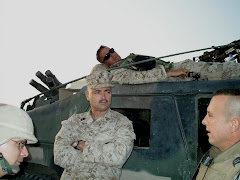
I’m actually reading in Standto that starting late in FY 08 , all Army bands will be changed to organize bands into separately deployable/employable Music Support Teams (MST). These organizations can be deployed alone or combined with other MSTs to provide different types of music support.
I may get some flak from the Band members out there, but something strikes me odd that we are deploying soldiers as band members and hiring contractors to provide security…. Shouldn’t that be reversed? Frankly I think we would have fewer issues with hiring bands to fill needs for “music support” using same contract vehicles we used for cooks, etc in combat theaters. We reduced the number of Army Cooks years ago recognizing we could contract those skills and the result is much better selection and faire in dining facilities in the combat theater.
Why are we training a number of soldiers to fill roles that are prevalent in the civilian workforce… and it may not be PC to say this, I’d rather have an IPOD for my music support than lose the count of one soldier to play an instrument. If there are 20 soldiers in each band element across 10 organizations we are spending 200 soldiers to produce music I can get in a simple electronic gadget. (Although as a disclaimer, I don’t have much martial or band music on mine)
We need to rethink all aspects of our army to improve efficiency for every soldier trained. Antiquated Victorian institutions such as Army Division Bands don’t fit well in an organization that is struggling to maintain adequate warfighters in boots on the ground.
Thursday, March 13, 2008


Tuesday, March 11, 2008
Looking back at one mediocre assignment

I looked into AKO to review a document and decided to see where I was 5 years ago. I do this once in a while because I am still amazed at the rapid course of events that have occurred since my departure from the Army Reserves.
I opened and read an evaluation report from 5 years ago – 1993 when I was assigned as a new Battalion commander in the 98th Division. As it turns out it was the only bad report I ever received in my career. I got this OER from a Col Mike Smith (no relation) now BG Mike Smith after my Battalion was noted as the Best QM training Battalion in the Army. For those of you that are unfamiliar with the Army system – one bad report effectively kill your chances for advancement, even in the Army Reserve.
Oddly enough my successive Battalion Command reports were very good from the same Colonel Smith, but they changed nothing. I illustrate this phenomenon because every Officer reached their high water mark in their careers just as I did 5 years ago. It may be objection to policies, procedures, or misguided priorities or other failing that marks the jump the shark moment for any officer. The strange thing that occurs just after that realization is the new empowerment to speak your mind and become much more forceful in shaping organizational success…after all you no longer has anything to fear.
Perhaps if senior leadership facing down the Secretary of Defense in 2003 had jumped the shark and had no hope of advancement they too would have been more proactive in engaging the plan that later faltered in execution. Often the most ineffective leaders are the folks worried about their careers and shaping every decision to preserve advancement momentum. Perhaps those leaders that speak their mind and commit career suicide deserve more of the spotlight for making the tough decision that is truly selfless. And to think I come up with this stuff from just looking at my one bad OER.
Wednesday, March 05, 2008
VA process remains broken
There is a systematic failure in both Department of Defense (DoD) and Department of Veterans Affairs (VA) programs designed to address the medical and overall readjustment needs of war veterans. There is no plan to gather usable data and monitor the 1.5 million deployed Operation Enduring Freedom and Operation Iraqi Freedom (OEF/OIF) service members as they return to duty or reintegrate into civilian society. The continued incomplete process of reintegrating soldiers, especially Guard and Reserve Soldiers is an indicator of continued process deficiencies.
DoD currently requires service members to answer a limited questionnaire to determine if they need to be referred for treatment upon their return from a combat theater. Soldiers are typically rushed to return home after a deployment and do not necessarily give these questions sufficient attention, nor have they changed gears from mission first mentality.
I returned from OIF as a Reservist in 2005. DoD had no provision for me or any member of my unit to obtain physicals or evaluation. As individually mobilized Reserve Soldiers we were swiftly processed, lock step, over 4 days at Ft. Bliss and shipped home. I went to the VA about a month after my return to civilian life (had to take leave from my civilian job) and in the course of trying to get my initial medical screen was assaulted by a Phlebotomist at the Clinic. So the Bottom line - no medical exam, check-up, evaluation, etc... for this Reserve Soldier. My story is not unique and many others can be found online... DoD and VA net effort to identify, treat and reintegrate is near zero and broken.
As a status check if the system we see the reported rise in the backlog of more than 100,000 claims in two years. The continued absence of consistently prompt mental health referrals as part of Post-Deployment Health Assessment process. Half as many members of the Guard and Reserve file disability claims as compared to active duty veterans and these claims are rejected at twice the rate. Frankly, after 24 years in the Army Reserve, I don’t have a clue how to even start a claim, nor is anyone inclined to step up and assist as I’m now retired.
I believe its time to insist that VA and DoD better coordinate efforts and become more proactive. Efforts to effectively share medical information are underway but still far short of what is needed. My medical records from the mobilization were unceremoniously put in an envelope and mailed to my house… no one reviewed, followed up or checked them. I could not get a physical or even medical attention at Bliss within the month I returned as facilities were overwhelmed. The effort at that post at the time being nearly completely invested in those getting ready to deploy. To be fair DoD should conduct mandatory in-person physical and mental health exams with every service member 30 to 90 days after deployment.
The current system still reflects a bias that was relevant before Guard and Reserve soldiers became part of an operational reserve. Little has been done to change the support structure for Reserve component unique challenges in either the VA or DoD. Efforts to integrate the resources of DoD and the VA must be continued beyond sharing medical data to include a true plan of action for citizen soldiers health care in light of the greater reliance of the nation upon their services.
DoD currently requires service members to answer a limited questionnaire to determine if they need to be referred for treatment upon their return from a combat theater. Soldiers are typically rushed to return home after a deployment and do not necessarily give these questions sufficient attention, nor have they changed gears from mission first mentality.
I returned from OIF as a Reservist in 2005. DoD had no provision for me or any member of my unit to obtain physicals or evaluation. As individually mobilized Reserve Soldiers we were swiftly processed, lock step, over 4 days at Ft. Bliss and shipped home. I went to the VA about a month after my return to civilian life (had to take leave from my civilian job) and in the course of trying to get my initial medical screen was assaulted by a Phlebotomist at the Clinic. So the Bottom line - no medical exam, check-up, evaluation, etc... for this Reserve Soldier. My story is not unique and many others can be found online... DoD and VA net effort to identify, treat and reintegrate is near zero and broken.
As a status check if the system we see the reported rise in the backlog of more than 100,000 claims in two years. The continued absence of consistently prompt mental health referrals as part of Post-Deployment Health Assessment process. Half as many members of the Guard and Reserve file disability claims as compared to active duty veterans and these claims are rejected at twice the rate. Frankly, after 24 years in the Army Reserve, I don’t have a clue how to even start a claim, nor is anyone inclined to step up and assist as I’m now retired.
I believe its time to insist that VA and DoD better coordinate efforts and become more proactive. Efforts to effectively share medical information are underway but still far short of what is needed. My medical records from the mobilization were unceremoniously put in an envelope and mailed to my house… no one reviewed, followed up or checked them. I could not get a physical or even medical attention at Bliss within the month I returned as facilities were overwhelmed. The effort at that post at the time being nearly completely invested in those getting ready to deploy. To be fair DoD should conduct mandatory in-person physical and mental health exams with every service member 30 to 90 days after deployment.
The current system still reflects a bias that was relevant before Guard and Reserve soldiers became part of an operational reserve. Little has been done to change the support structure for Reserve component unique challenges in either the VA or DoD. Efforts to integrate the resources of DoD and the VA must be continued beyond sharing medical data to include a true plan of action for citizen soldiers health care in light of the greater reliance of the nation upon their services.
Monday, March 03, 2008
Installation Services for EAP
Recently the small Army Installation where I work sent out a missive in front of a Army inspection (often the inspection process causes information to flow as no other time it seems) concerning the installation's Employee Assistance Program. I learned that EAP is a is a comprehensive program designed to address problems that can adversely affect job performance, reliability, and personal health issues. The program can also address substance abuse and addiction related issues for drugs/alcohol. The program is confidential ,f you choose to use the short-term counseling service, no one will know you are using the service unless you tell him or her.
I noted the attention given to this program with its potential assistance for former combat zone veteran's like myself remains pretty buried in the menu of support this installation gives its community. I recieved countless notes related to golf club, Restaurant and other Installation agencies, but only once in 4 years any information that a EAP was even here.
I guess its a indicator of the greater stigma that surrounds PTSD, soldier and civilian employee mental health that keeps such programs in the background. The Army has done much to work the issues that restricted access to mental health resources with the Wounded Warrior program. We can do more for Military and Civilians alike - sometimes, as in this case, we already have programs for in installations. Maybe we should endeavor to push those services a little harder in the Army Community.
I noted the attention given to this program with its potential assistance for former combat zone veteran's like myself remains pretty buried in the menu of support this installation gives its community. I recieved countless notes related to golf club, Restaurant and other Installation agencies, but only once in 4 years any information that a EAP was even here.
I guess its a indicator of the greater stigma that surrounds PTSD, soldier and civilian employee mental health that keeps such programs in the background. The Army has done much to work the issues that restricted access to mental health resources with the Wounded Warrior program. We can do more for Military and Civilians alike - sometimes, as in this case, we already have programs for in installations. Maybe we should endeavor to push those services a little harder in the Army Community.
Wednesday, February 13, 2008
Wanting to be there
I was approached the other day by a former National Guard soldier that was deployed about the same time as I in 2005. This soldier was deployed to an overseas assignment with his unit which by all accounts did a great job in their assignment. He was telling me that he has also since retired and has recently found out that his unit is now being sent to Iraq. The purpose of the discussion coming from him was related to his feelings of concern for the soldiers he served with previously that now will be departing for another operation without him.
It was clear that he was somewhat in turmoil and distraught at the thought that the young soldiers were somehow going to be cheated by the lack of his efforts in this deployment. It was almost as if he was no longer in the race anymore like a stallion in the paddock looking out at the track and unable to trot the course. He expressed a desire to somehow join what I would describe as a young man’s effort, but knew that is not possible for him anymore.
Its really not so curious how this former NCO had come to view his soldiers as his personal charge over years of dedicated service. The sad part of the conversation was that he and I sat and reminisced about we accomplished in molding our soldiers to be able to take on the roles they now face in their deployment. That in and of itself is an Army process that repeats itself innumerable times at all organizations. The life of a soldier from rookie private of Lieutenant to mid grade leader to senior leader and all of the sudden – on the outside swelling with pride and sadness that your soldiers can carry on so efficiently without you. The mark of success I suppose, but still doesn’t make the departure of our own any easier.
It was clear that he was somewhat in turmoil and distraught at the thought that the young soldiers were somehow going to be cheated by the lack of his efforts in this deployment. It was almost as if he was no longer in the race anymore like a stallion in the paddock looking out at the track and unable to trot the course. He expressed a desire to somehow join what I would describe as a young man’s effort, but knew that is not possible for him anymore.
Its really not so curious how this former NCO had come to view his soldiers as his personal charge over years of dedicated service. The sad part of the conversation was that he and I sat and reminisced about we accomplished in molding our soldiers to be able to take on the roles they now face in their deployment. That in and of itself is an Army process that repeats itself innumerable times at all organizations. The life of a soldier from rookie private of Lieutenant to mid grade leader to senior leader and all of the sudden – on the outside swelling with pride and sadness that your soldiers can carry on so efficiently without you. The mark of success I suppose, but still doesn’t make the departure of our own any easier.
Now somewhere, there stands the man
His duty o'er and won
The world will ne'er forget him
To him we say, "Well done."
from Old Soldiers Never Die
(Gene Autry, William Burch and Carl Cotner)
Monday, February 11, 2008
Military Truths
Seen this several times before - still agree with its basic tenor - invokes a laugh.
"Dear Civilians, "We know that the current state of affairs in our great nation has many civilians up in arms and excited to join the military. For those of you who can't join, you can still lend a hand. Here are a few of the areas where we would like your assistance:
(1) The next time you see an adult talking (or wearing a hat) during the playing of the National Anthem---kick their ass.
(2) When you witness, firsthand, someone burning the American Flag in protest---kick their ass.
(3) Regardless of the rank they held while they served, pay the highest amount of respect to all veterans. If you see anyone doing otherwise, quietly pull them aside and explain how these veterans fought for the very freedom they bask in every second. Enlighten them on the many sacrifices these veterans made to make this Nation great. Then hold them down while a disabled veteran kicks their ass.
(4) (GUYS) if you were never in the military, DO NOT pretend that you were. Wearing battle dress uniforms (BDUs), telling others that you used to be "Special Forces," and collecting GI Joe memorabilia might have been okay when you were seven years old. Now, it will only make you look stupid and get your ass kicked.
(5) Next time you come across an Air Force member, do not ask them, "Do you fly a jet?" Not everyone in the Air Force is a pilot. Such ignorance deserves an ass kicking (children are exempt).
(6) If you witness someone calling the US Coast Guard 'non-military', inform them of their mistake---and kick their ass.
(7) Next time Old Glory (the US flag) prances by during a parade, get on your damn feet and pay homage to her by placing your hand over your heart. Quietly thank the military member or veteran lucky enough to be carrying her---of course, failure to do either of those could earn you a severe ass kicking.
(8) Don't try to discuss politics with a military member or a veteran. We are Americans, and we all bleed the same, regardless of our party affiliation. Our Chain of Command is to include our Commander-In-Chief (C in C). The President (for those who didn't know) is our C in C regardless of political party. We have no inside track on what happens inside those big important buildings where all those representatives meet. All we know is that when those civilian representatives screw up the situation, they call upon the military to go straighten it out. If you keep asking us the same stupid questions repeatedly, you will get your ass kicked!
(9) 'Your mama wears combat boots' never made sense to me---stop saying it! If she did, she would most likely be a vet and therefore, could kick your ass!
(10) Bin Laden and the Taliban are not Communists, so stop saying 'Let's go kill those Commies! And stop asking us where he is! Crystal balls are not standard issue in the military. That reminds me- --if you see anyone calling those damn psychic phone numbers, let me know, so I can go kick their ass.
(11) 'Flyboy' (Air Force), 'Jarhead' (Marines), 'Grunt' (Army), 'Squid' (Navy), 'Puddle Jumpers' (Coast Guard), etc., are terms of endearment we use describing each other. Unless you are a service member or vet, you have not earned the right to use them. That could get your ass kicked.
(12) Last, but not least, whether or not you become a member of the military, support our troops and their families. Every Thanksgiving and religious holiday that you enjoy with family and friends, please remember that there are literally thousands of sailors and troops far from home wishing they could be with their families. Thank God for our military and the sacrifices they make every day. Without them, our country would get its ass kicked."
"It is the soldier, not the reporter who has given us the freedom of the press.
"It is the soldier, not the poet, who has given us the freedom of speech.
"It is the soldier, not the campus organizer, who gives us the freedom to demonstrate.
"It is the soldier who salutes the flag, who serves beneath the flag, and whose coffin is draped by the flag, who allows the protester to burn the flag."
"If you can read this, thank a teacher"
"If you are reading it in English, thank a veteran."
"The U.S. Constitution doesn't guarantee happiness, only the pursuit of it. You have to catch up to it yourself." - Benjamin Franklin
"Dear Civilians, "We know that the current state of affairs in our great nation has many civilians up in arms and excited to join the military. For those of you who can't join, you can still lend a hand. Here are a few of the areas where we would like your assistance:
(1) The next time you see an adult talking (or wearing a hat) during the playing of the National Anthem---kick their ass.
(2) When you witness, firsthand, someone burning the American Flag in protest---kick their ass.
(3) Regardless of the rank they held while they served, pay the highest amount of respect to all veterans. If you see anyone doing otherwise, quietly pull them aside and explain how these veterans fought for the very freedom they bask in every second. Enlighten them on the many sacrifices these veterans made to make this Nation great. Then hold them down while a disabled veteran kicks their ass.
(4) (GUYS) if you were never in the military, DO NOT pretend that you were. Wearing battle dress uniforms (BDUs), telling others that you used to be "Special Forces," and collecting GI Joe memorabilia might have been okay when you were seven years old. Now, it will only make you look stupid and get your ass kicked.
(5) Next time you come across an Air Force member, do not ask them, "Do you fly a jet?" Not everyone in the Air Force is a pilot. Such ignorance deserves an ass kicking (children are exempt).
(6) If you witness someone calling the US Coast Guard 'non-military', inform them of their mistake---and kick their ass.
(7) Next time Old Glory (the US flag) prances by during a parade, get on your damn feet and pay homage to her by placing your hand over your heart. Quietly thank the military member or veteran lucky enough to be carrying her---of course, failure to do either of those could earn you a severe ass kicking.
(8) Don't try to discuss politics with a military member or a veteran. We are Americans, and we all bleed the same, regardless of our party affiliation. Our Chain of Command is to include our Commander-In-Chief (C in C). The President (for those who didn't know) is our C in C regardless of political party. We have no inside track on what happens inside those big important buildings where all those representatives meet. All we know is that when those civilian representatives screw up the situation, they call upon the military to go straighten it out. If you keep asking us the same stupid questions repeatedly, you will get your ass kicked!
(9) 'Your mama wears combat boots' never made sense to me---stop saying it! If she did, she would most likely be a vet and therefore, could kick your ass!
(10) Bin Laden and the Taliban are not Communists, so stop saying 'Let's go kill those Commies! And stop asking us where he is! Crystal balls are not standard issue in the military. That reminds me- --if you see anyone calling those damn psychic phone numbers, let me know, so I can go kick their ass.
(11) 'Flyboy' (Air Force), 'Jarhead' (Marines), 'Grunt' (Army), 'Squid' (Navy), 'Puddle Jumpers' (Coast Guard), etc., are terms of endearment we use describing each other. Unless you are a service member or vet, you have not earned the right to use them. That could get your ass kicked.
(12) Last, but not least, whether or not you become a member of the military, support our troops and their families. Every Thanksgiving and religious holiday that you enjoy with family and friends, please remember that there are literally thousands of sailors and troops far from home wishing they could be with their families. Thank God for our military and the sacrifices they make every day. Without them, our country would get its ass kicked."
"It is the soldier, not the reporter who has given us the freedom of the press.
"It is the soldier, not the poet, who has given us the freedom of speech.
"It is the soldier, not the campus organizer, who gives us the freedom to demonstrate.
"It is the soldier who salutes the flag, who serves beneath the flag, and whose coffin is draped by the flag, who allows the protester to burn the flag."
"If you can read this, thank a teacher"
"If you are reading it in English, thank a veteran."
"The U.S. Constitution doesn't guarantee happiness, only the pursuit of it. You have to catch up to it yourself." - Benjamin Franklin
Wednesday, February 06, 2008
Combat Lifesaver Training

The combat lifesaver (CL) is a nonmedical Soldier trained to provide emergency care as a secondary mission. Each squad and crew should have at least one member trained to be a Combat Lifesaver. Most organizations train all assigned soldeirs to be combat lifesavers.
The following is extracted from Army Regulation 350-1 , Army Training and Education , 9 April 2003 .
… Immediate, far-forward medical care is essential on a widely dispersed and fluid battlefield to prevent soldiers from dying of wounds. Medical personnel may not be able to reach and apply lifesaving measures to all wounded soldiers in a timely manner. The combat lifesaver is a nonmedical soldier trained to provide lifesaving measures beyond the level of self-aid or buddy-aid. A properly trained combat lifesaver is capable of stabilizing many types of casualties and can slow the deterioration of a wounded soldier’s condition until medical personnel arrive. Functioning as a combat lifesaver is a secondary mission undertaken when the tactical situation permits.
The Army has added Combat Lifesaver training for most soldiers deploying including the soldier that appears in the picture above. The skills include Casualty Excavation, Airway Management, Chest Injury management, Controlling Bleeding, IV therapy (as seen here) and requesting Medical Evacuation.
From the response I received from the soldier pictured, it is a sobering training event that reinforces the reality that the soldiers are deploying to a hostile environment. The initiative to train soldiers in combat lifesaver skills is beneficial in the end as lives are saved.
To me the picture and knowledge of the training are indicators of the difference in the lives of soldiers and civilians. The 19 Year old soldier in the picture has friends that are most concerned with Shopping Mall sales, clothes and material things while the young soldier must learn how to save a life in a combat zone. The dichotomy between lives for todays soldiers, especially citizen soldiers has never been so significant as it is today.
Thursday, January 31, 2008
Let Soldier’s Blog
General Caldwell is quoted in Government Executive Com, Jan 30th issue in an article by Greg Grant
As you have read here – there is a significant counter position to allowing such free reign to Blog sites, video sites and the like within the walls of the Pentagon. General Caldwell has clearly grasped that the digital internet era warrants a relook at the resources we have in soldier Blooging. Therein lies the potential to have a sustainable information warfare counter to the information battle that is being waged across the internet spectrum.
He suggested in the article that unit leaders be given camcorders to document combat operations and daily life. He grasps that there is an importance in being able to immediately access an audience of millions. Noted in the article is the fact that there are MilBloggers out there willing to overcome the red tape imposed by the August 2006 Pentagon memo which forbade personnel from placing any information on public Web sites unless it was reviewed for possible security violations and approved for distribution by commanders.
I have noted here previously that it is a struggle to overcome bureaucratic reluctance to allow blogging within the military establishment. The resistance extends event to retiredreservist at times as a result of the Pentagon restrictions. These restrictions quantified in the current rules are subjective to to a wide range of interpretation. Within the milblogging community this may be translated to absolute censorship or open latitude for bloggers. The restriction on using military computers (often the only machines available in theater) further suppresses the good message from our soldiers in the field.
General Caldwell has got it right with regard to the need to relook the current policy and improve our counter message to that of the enemy. We must realize that our soldiers come from a great cross section of the country they serve and as a result are best positioned to influence the masses on notion that we are doing good work.
To compete in the global information war played out on Web sites and e-mail, soldiers in Iraq should upload videos of their experiences in the combat zone to YouTube and post their personal stories online.
As you have read here – there is a significant counter position to allowing such free reign to Blog sites, video sites and the like within the walls of the Pentagon. General Caldwell has clearly grasped that the digital internet era warrants a relook at the resources we have in soldier Blooging. Therein lies the potential to have a sustainable information warfare counter to the information battle that is being waged across the internet spectrum.
He suggested in the article that unit leaders be given camcorders to document combat operations and daily life. He grasps that there is an importance in being able to immediately access an audience of millions. Noted in the article is the fact that there are MilBloggers out there willing to overcome the red tape imposed by the August 2006 Pentagon memo which forbade personnel from placing any information on public Web sites unless it was reviewed for possible security violations and approved for distribution by commanders.
I have noted here previously that it is a struggle to overcome bureaucratic reluctance to allow blogging within the military establishment. The resistance extends event to retiredreservist at times as a result of the Pentagon restrictions. These restrictions quantified in the current rules are subjective to to a wide range of interpretation. Within the milblogging community this may be translated to absolute censorship or open latitude for bloggers. The restriction on using military computers (often the only machines available in theater) further suppresses the good message from our soldiers in the field.
General Caldwell has got it right with regard to the need to relook the current policy and improve our counter message to that of the enemy. We must realize that our soldiers come from a great cross section of the country they serve and as a result are best positioned to influence the masses on notion that we are doing good work.
Tuesday, January 29, 2008
Reserve Component Community Based Health
Read in yesterday’s Stand-to magazine about The Army’s program called The Community Based Health Care Organization (CBHCO). This program allows a recuperating Reserve Component Soldier to obtain services from medical facilities near home, while remaining on active duty.
As stated
This is a great leap forward in treating and caring for Reserve and Guard soldiers that allows application of localized comprehensive care to Guard and Reserve soldiers. Now there are quantified instructions address duty status, reassignment actions, personnel accountability, evaluation reports, promotion, pay, release from active duty (REFRAD) procedures, retirement, and discharge for Soldiers who fall into various categories in deployment medical care. The rules cover care for soldiers who fail pre-deployment screening, become injured or Ill during deployment and post deployment care.
Based upon personal experience this is a vast improvement over the medical care available as recently as 3-4 years ago and reflects the Army medical and human Capital elements recognizing the deficit and improving upon the delivery of medical care to Reserve and Guard soldiers.
Its early, but I think we have a course for better care of our Reserve Component soldiers thanks to their efforts.
As stated
CBHCOs provide Reserve Component Warriors in Transition (WTs) high-quality health care and administrative processing through nine CBHCO units, managing more than 1,300 Soldiers, who live in all parts of the country.
Medical retention processing units are located at the following installations:
Fort Dix Fort Carson
Fort Drum Fort Lewis
Fort Eustis Fort Riley
Aberdeen Proving Ground Camp Atterbury
Fort Lee Fort McCoy
Fort Benning Fort Leonard Wood
Fort Bragg Fort Bliss
Fort Campbell Fort Hood
Fort Stewart Fort Polk
Fort Buchanan Fort Sill
Fort Jackson Fort Huachuca
Fort Knox Fort Sam Houston
Fort Rucker
Additionally CBHCOs will be established at the following locations:
Massachusetts
Arkansas
Wisconsin
Florida
California
This is a great leap forward in treating and caring for Reserve and Guard soldiers that allows application of localized comprehensive care to Guard and Reserve soldiers. Now there are quantified instructions address duty status, reassignment actions, personnel accountability, evaluation reports, promotion, pay, release from active duty (REFRAD) procedures, retirement, and discharge for Soldiers who fall into various categories in deployment medical care. The rules cover care for soldiers who fail pre-deployment screening, become injured or Ill during deployment and post deployment care.
Based upon personal experience this is a vast improvement over the medical care available as recently as 3-4 years ago and reflects the Army medical and human Capital elements recognizing the deficit and improving upon the delivery of medical care to Reserve and Guard soldiers.
Its early, but I think we have a course for better care of our Reserve Component soldiers thanks to their efforts.
Monday, January 28, 2008
ADT or Active Duty
I was reminded yesterday of what may seem a minor issue when looking at an LES of a deployed soldier brought to me at my Veteran's association. Seems the soldier’s parent did not understand why the status for the Reserve soldier reflects active duty for training (ADT) when the soldier is in fact hardly training, but rather serving in a combat theater at the moment. I noted my own LES from my deployment reflected AT/ADT when I was in Iraq as well.
I imagine a bureaucrat in Army can tell me the reason for the coding to reflect AT/ADT when in fact a Reserve soldier is on Active duty. But try to explain that to veteran organizations, family members and others. Also note that at least for me, and I suspect other Reserve soldiers, its more of the “your still a Reservist” mentality creeping in so that even you pay document cannot note that you are on Active Duty and not some “training period”.
It may seem like a little thing – but it is an irritant. How about we change the status to reflect active duty when appropriate on a document we send to about 70000 soldiers that are deployed every two weeks and note they are not just training. It is just a little thing.
I imagine a bureaucrat in Army can tell me the reason for the coding to reflect AT/ADT when in fact a Reserve soldier is on Active duty. But try to explain that to veteran organizations, family members and others. Also note that at least for me, and I suspect other Reserve soldiers, its more of the “your still a Reservist” mentality creeping in so that even you pay document cannot note that you are on Active Duty and not some “training period”.
It may seem like a little thing – but it is an irritant. How about we change the status to reflect active duty when appropriate on a document we send to about 70000 soldiers that are deployed every two weeks and note they are not just training. It is just a little thing.
Thursday, January 17, 2008
My Baby is a soldier - update
My daughter graduated High School last year completed OSUT which is Basic Training then advanced individual Military skill training (AIT) immediately following. She arrived at her Reserve Unit for December’s Drill assembly.
She has since been deployed with the unit and is stationed at a stateside training base for a couple months training prior to deployment. She receive her alert, and orders for Mobilization on a Friday and was on the bus to the training site on the following Tuesday. As you can imagine, the weekend in between was fast paced with packing gear and getting all the requisite actions complete before shipping off.
I wrote about my daughter’s progress through the training process before and I remain in marvel of the system that transformed my little Girl into a soldier.
I visited her unit the 744th MP Battalion, and immediately discovered soldiers and Officers I knew in various previous assignments – as they say the Army is a small place at times. Even as an old salt, I was impressed with the efficiency, team atmosphere, competence and determination of the unit’s leaders and members. They were getting things accomplished to move out on their mission.
I also met many other families at the 744th Reserve Center and know it is a tough thing for them to say farewell for a while as their sons, daughters, spouses and partners depart. I don’t know to what extent that many families know of the task that is ahead of the unit – the hurry up and waits, training, movement and deployment.
I know from my own experience, just as it is for my daughter, that the activities for the deploying unit are charged with apprehension, trepidation but also a sense of pride. For unit members are now called forward as soldiers to serve their country. The basis for this service goes back to the very foundation of the country when then as now, citizen soldiers answered the call.
I will write again about this unit – one and all embody the term – soldier strong.
She has since been deployed with the unit and is stationed at a stateside training base for a couple months training prior to deployment. She receive her alert, and orders for Mobilization on a Friday and was on the bus to the training site on the following Tuesday. As you can imagine, the weekend in between was fast paced with packing gear and getting all the requisite actions complete before shipping off.
I wrote about my daughter’s progress through the training process before and I remain in marvel of the system that transformed my little Girl into a soldier.
I visited her unit the 744th MP Battalion, and immediately discovered soldiers and Officers I knew in various previous assignments – as they say the Army is a small place at times. Even as an old salt, I was impressed with the efficiency, team atmosphere, competence and determination of the unit’s leaders and members. They were getting things accomplished to move out on their mission.
I also met many other families at the 744th Reserve Center and know it is a tough thing for them to say farewell for a while as their sons, daughters, spouses and partners depart. I don’t know to what extent that many families know of the task that is ahead of the unit – the hurry up and waits, training, movement and deployment.
I know from my own experience, just as it is for my daughter, that the activities for the deploying unit are charged with apprehension, trepidation but also a sense of pride. For unit members are now called forward as soldiers to serve their country. The basis for this service goes back to the very foundation of the country when then as now, citizen soldiers answered the call.
I will write again about this unit – one and all embody the term – soldier strong.
Friday, January 11, 2008
Update on PV2 Smith
PV2 Smith has been attending annual Training since her return back to Pennsylvania with her Reserve Unit. She arrived and discovered that her unit was preparing for deployment soon overseas, however she was at the time excess and not scheduled to depart with the unit.
Today that has changed - she was informed that she will be departing with the unit next week for training and subsequent deployment overseas. She called me as her father and we discussed the enormity of the implications for her life, now the delay in starting school and the work that must be done to prepare for deployment.
Many Reserve soldiers are similarly faced with the daunting task of completely changing their lives to prepare for and complete training and deployment. It is an emotional event in the life of any soldier and my 18 year old daughter is no different. Her friends, extended family and community don't really understand the calling, the feelings or the apprehension of going away for a year to a war zone to serve your country. Its a committment that we as a country don't always reward or recognized in proportion to the all out effort entailed by the soldier to serve with honor.
I knew this day was possible, and in light of the statistics for Reserve soldier deployments, expected it would occur soon. It is no easier having experienced the event as a soldier myself to see my little one getting ready to go...the only consolation is I know she is Army Strong - something that is more than a saying - it is a way of life.
Today that has changed - she was informed that she will be departing with the unit next week for training and subsequent deployment overseas. She called me as her father and we discussed the enormity of the implications for her life, now the delay in starting school and the work that must be done to prepare for deployment.
Many Reserve soldiers are similarly faced with the daunting task of completely changing their lives to prepare for and complete training and deployment. It is an emotional event in the life of any soldier and my 18 year old daughter is no different. Her friends, extended family and community don't really understand the calling, the feelings or the apprehension of going away for a year to a war zone to serve your country. Its a committment that we as a country don't always reward or recognized in proportion to the all out effort entailed by the soldier to serve with honor.
I knew this day was possible, and in light of the statistics for Reserve soldier deployments, expected it would occur soon. It is no easier having experienced the event as a soldier myself to see my little one getting ready to go...the only consolation is I know she is Army Strong - something that is more than a saying - it is a way of life.
Thursday, January 10, 2008
Beanie Babies lead the way

I was amused to see the quote yesterday in the Army’s Stand-to E-Mail newsletter
SENIOR LEADERS ARE SAYING
“Relationships are what this is all about. I think, in truth, relationships are what everything is all about, whether our own home life or international relations. And all we are trying to do is, sort of, one handshake at a time or one smile at a time, one Beanie Baby at a time, to add a little joy and strength to this relationship.”
--Gen. David H. Petraeus, emphasizing the importance of relationships in achieving common goals in Iraq.
As a member of GEN Petraeus’s MNSTC-I staff I had the opportunity to develop relationships with many Iraqi people…at the Ministry level and out in the countryside. A tenet constantly reinforced in every transaction, meeting and event in MNSTC-I was the partnership aspect in creating conditions for success in Iraq.
I happened to receive a case of Beanie Babies from a co-worker stateside while in Iraq and took the opportunity to hand them out as I did to this little guy. It seemed natural to treat the Iraqi’s with respect and friendship in the environment at MNSTC-I. GEN Petraeus knew we often gave stuff out at the various sites…he demanded fairness and partnership with Iraqis and their Leadership for all members of the command.
If we could apply his model on a larger scale – the ability to add a little joy and strength to a relationship - we just may prevail.
Thursday, December 27, 2007
Army Blogosphere Access
Recently I discovered a Bloggers source material site set up by DoD
Interesting that Blogger resources are offered at DoD but meanwhile the Army has reinforced its approach to restricting and curbing Blogging as noted in its regulations (cited below) and in its restrictions to internet browsing and access to many mainstream blogging sites used by milbloggers.
Now it appears for the last several months that the Army has further restricted and blocked access to Blog sites for Military and civilian personnel. While many might argue the current Army intent, I would offer that many Blog sites offer a open and diverse perspective that would be useful for the Army to view for a wide scope of application – Public affairs, Soldier input to support, Family issues, R&D activities.
Curiously Army personnel can still access Al Jazeera news sites but cannot read many of the blogs in the Army’s stand-to magazine, including this one, if they sitting at an army hosted machine. The restrictions actually do not allow my supervisor to review my blog (yes I follow the AR requirements) from his work address and attempts to address with IM community are fruitless.
It is a reflection of knee jerk techno scared senior leadership mandates that restricts access and exploitation of the good Army message using the Blogosphere. We should see the advantage offered by using the tools that are available to tell our story – after all the other side is offering an increasingly uncontested point of view.
The Bloggers' Roundtable http://www.defenselink.mil/Blogger/Blogger.aspx provides source material for stories in the blogosphere concerning the Department of Defense (DoD) and the Global War on Terrorism by bloggers and online journalists. Where available, this includes transcripts, biographies, related fact sheets and video.
Interesting that Blogger resources are offered at DoD but meanwhile the Army has reinforced its approach to restricting and curbing Blogging as noted in its regulations (cited below) and in its restrictions to internet browsing and access to many mainstream blogging sites used by milbloggers.
Army Regulation 530--1: Operations Security (OPSEC) (.pdf) restricts more than just blogs, however. Previous editions of the rules asked Army personnel to "consult with their immediate supervisor" before posting a document "that might contain sensitive and/or critical information in a public forum." The new version, in contrast, requires "an OPSEC review prior to publishing" anything -- from "web log (blog) postings" to comments on internet message boards, from resumes to letters home.
Now it appears for the last several months that the Army has further restricted and blocked access to Blog sites for Military and civilian personnel. While many might argue the current Army intent, I would offer that many Blog sites offer a open and diverse perspective that would be useful for the Army to view for a wide scope of application – Public affairs, Soldier input to support, Family issues, R&D activities.
Curiously Army personnel can still access Al Jazeera news sites but cannot read many of the blogs in the Army’s stand-to magazine, including this one, if they sitting at an army hosted machine. The restrictions actually do not allow my supervisor to review my blog (yes I follow the AR requirements) from his work address and attempts to address with IM community are fruitless.
It is a reflection of knee jerk techno scared senior leadership mandates that restricts access and exploitation of the good Army message using the Blogosphere. We should see the advantage offered by using the tools that are available to tell our story – after all the other side is offering an increasingly uncontested point of view.
Wednesday, December 19, 2007
Supporting our Soldiers
I often get asked what to send to soldiers by family members, friends, legion members. Often times I like to take time to discover the individual that they are sending packages to or learn that they feel a need to do something for military personnel stationed overseas during the Holidays. Many of the things I received in country were through the kindness of people sending stuff through organizations of companies that worked to acknowledge the service of sldiers – especially over the holidays.
Nothing beats a letter, package from loved ones sent directly to a soldier… Its easy enough to do once you have the soldiers address in country… its so great to get mail. If you don’t know a soldier serving personally, the military no longer accepts mail addressed to "Any Service Member" but there are still dozens of ways you can show your support to the American Soldier and the U.S. Army.
Many independent organizations are ready and willing to help support the troops. You can go to this site to get a short list of organizations that will help you send messages, packages and other mementos of support to troops.
http://www4.army.mil/outreach/support/
Most of the organizations listed are nonpartisan, non-political groups and organizations that work to support U.S. deployed and wounded troops in harm's way. Many are managed by volunteers.
Take a moment this holiday season to check out the support agencies and see if you can support our soldiers…I can say on behalf of one former soldier that it is certainly appreciated.
Nothing beats a letter, package from loved ones sent directly to a soldier… Its easy enough to do once you have the soldiers address in country… its so great to get mail. If you don’t know a soldier serving personally, the military no longer accepts mail addressed to "Any Service Member" but there are still dozens of ways you can show your support to the American Soldier and the U.S. Army.
Many independent organizations are ready and willing to help support the troops. You can go to this site to get a short list of organizations that will help you send messages, packages and other mementos of support to troops.
http://www4.army.mil/outreach/support/
Most of the organizations listed are nonpartisan, non-political groups and organizations that work to support U.S. deployed and wounded troops in harm's way. Many are managed by volunteers.
Take a moment this holiday season to check out the support agencies and see if you can support our soldiers…I can say on behalf of one former soldier that it is certainly appreciated.
Thursday, December 13, 2007
When is a Veteran not a Veteran
Another case of Reserve bias – recently approached and asked about a headstone for a Reserve soldier that was Reserve entire career. The Reservist did not die on active duty and did not retire from the reserves. Only duty performed on active duty was for Basic training and Desert Storm…both served honorably but neither up to 24 months. Entitled to a headstone or marker ? The answer is no …and would remain so even if deployed several more times
From the VA site the regulation is specific in its intent to not provide for reserve and guard soldiers
Another policy which should be relooked considering the changed nature of Guard and Reserve duty.
From the VA site the regulation is specific in its intent to not provide for reserve and guard soldiers
MEMORIAL HEADSTONE OR MARKER - Furnished upon application for installation in a cemetery only to commemorate any eligible veteran whose remains have not been recovered or identified, were buried at sea, donated to science, or cremated and the remains scattered; may not be used as a memento.
WHO IS ELIGIBLE - Any deceased veteran discharged under conditions other than dishonorable. A copy of the deceased veteran's discharge certificate (DD Form 214 or equivalent) or a copy of other official document(s) establishing military service must be attached. Service after September 7, 1980, must be for a minimum of 24 months continuous active duty or be completed under special circumstances, e.g., death on active duty. Persons who have only limited active duty service for training while in the National Guard or Reserves are not eligible unless there are special circumstances, e.g., death while on active duty, or as a result of training.
Another policy which should be relooked considering the changed nature of Guard and Reserve duty.
Monday, December 10, 2007
Don’t ask, Don’t tell – how about I don’t care
It has been apparent that a lot of fervor has been raised in the press recently from the many published views placed in the media of the Don’t ask, Don’t tell issue with respect to gay and lesbians serving in the Military. It seems from my simple perspective that conservatives, military, politicians, and groups with specific agendas related to the issue of our policy towards gay American’s serving in the Military miss the basic premise of service.
As a former Company and Battalion commander I am sure I likely had gay individuals that served my unit with distinction. I also had members of all faiths, ideals, political affiliations, nationalities and demographics within the ranks similarly performing their jobs well. As a leader the unit performance demanded that individual issues, bias, and influences had to be set aside to work in a collaborative team atmosphere to get the job done. Frankly my soldiers did not have time, need or inclination to be concerned with politics, religion, sexual orientation – we were then, and soldiers continue to be, concerned with establishing effective, well trained teams that focus on the job at hand.
I needed the soldiers that served with me to be tactically and technically proficient in their military skills. Devotion to the unit mission, knowledge of soldier skills and professional completion of all duties assigned were items that concerned everyone assigned.
The demagoguery on the issue of Don’t Ask, Don’t Tell hysteria found in the political arena recently is hype that isn’t prevalent on the Military that I knew or the one that exists today. It is a fabrication used as a political chess piece which pits former military (is he a retired colonel or Brigadier General- who cares), activist groups and political candidates against each other but does not reflect the conditions or issue for soldiers… we are too busy for the flap about things unrelated to the task at hand.
As a former Company and Battalion commander I am sure I likely had gay individuals that served my unit with distinction. I also had members of all faiths, ideals, political affiliations, nationalities and demographics within the ranks similarly performing their jobs well. As a leader the unit performance demanded that individual issues, bias, and influences had to be set aside to work in a collaborative team atmosphere to get the job done. Frankly my soldiers did not have time, need or inclination to be concerned with politics, religion, sexual orientation – we were then, and soldiers continue to be, concerned with establishing effective, well trained teams that focus on the job at hand.
I needed the soldiers that served with me to be tactically and technically proficient in their military skills. Devotion to the unit mission, knowledge of soldier skills and professional completion of all duties assigned were items that concerned everyone assigned.
The demagoguery on the issue of Don’t Ask, Don’t Tell hysteria found in the political arena recently is hype that isn’t prevalent on the Military that I knew or the one that exists today. It is a fabrication used as a political chess piece which pits former military (is he a retired colonel or Brigadier General- who cares), activist groups and political candidates against each other but does not reflect the conditions or issue for soldiers… we are too busy for the flap about things unrelated to the task at hand.
Demagoguery - refers to a political strategy for obtaining and gaining political power by appealing to the popular prejudices, fears and expectations of the public — typically via impassioned rhetoric and propaganda, and often using nationalist or populist themes.
Tuesday, December 04, 2007
My Baby is a soldier
My daughter graduated High School last June and shipped to OSUT which is Basic Training then advanced individual Military skill training (AIT) immediately following. She just finished her OSUT (Basic and advanced individual Training) and has become a Beret wearing Hooah soldier.
I wrote about my daughter’s progress through the training process before – so this is another update – she completed Basic Training and AIT for Military Police at Ft. Leonard Wood, MO and returned back home in time for Thanksgiving several weeks ago. I remain in marvel of the system that transformed my little Girl into a soldier.
She is getting ready to step out to an affiliation with her Reserve Unit which is full of other members that have made the transition to citizen soldier military life . She will begin College in the Spring Semester and will remain ready for whatever call follows her unit in the future. She is committed to serving in any capacity assigned and knows the possibility of deployment is ever present in her position. She has morphed from the Mall Girl into a GI Jane of sorts, stronger, leaner and more determined to exceed…. I talk with her and realize that she is growing in maturity, poise, confidence to an extent that is never realized by many people…. She has gained it in 15 weeks in the Army.
So a tip of the Hat to the Drill Sergeants, process and leaders that comprise the community that transforms our teenagers into soldiers – I can personally attest that they have done a good job from my perspective in instilling pride, teamwork, Army Values and a sense of service into my little princess that now can handle an M16 as well.
I wrote about my daughter’s progress through the training process before – so this is another update – she completed Basic Training and AIT for Military Police at Ft. Leonard Wood, MO and returned back home in time for Thanksgiving several weeks ago. I remain in marvel of the system that transformed my little Girl into a soldier.
She is getting ready to step out to an affiliation with her Reserve Unit which is full of other members that have made the transition to citizen soldier military life . She will begin College in the Spring Semester and will remain ready for whatever call follows her unit in the future. She is committed to serving in any capacity assigned and knows the possibility of deployment is ever present in her position. She has morphed from the Mall Girl into a GI Jane of sorts, stronger, leaner and more determined to exceed…. I talk with her and realize that she is growing in maturity, poise, confidence to an extent that is never realized by many people…. She has gained it in 15 weeks in the Army.
So a tip of the Hat to the Drill Sergeants, process and leaders that comprise the community that transforms our teenagers into soldiers – I can personally attest that they have done a good job from my perspective in instilling pride, teamwork, Army Values and a sense of service into my little princess that now can handle an M16 as well.
Monday, November 12, 2007
Remember the Homeless Veterans
We just celebrated Veteran's day and it is a good time to reflect that some Veteran's are not well off. I'm refering to Homeless Veterans. Homeless veterans are a group often overlooked in this country. I really did not know the scope if the issue with homeless veterans and always assumed that veterans were a cross section in society and were homeless at the same rate as everyone else.
I have read into the issue and found the statistics a little discomforting as a soldier and thought I’d share some with you in the hopes that we all work to never leave a former soldier behind. From the Veteran’s Administration site (http://www1.va.gov/homeless/)
In these statistics one out of every three homeless men has worn a uniform and served this country. The U.S. Interagency Council on Homelessness and the Urban Institute, 1999 provides that roughly 1 in 4 of all homeless people in America are veterans.
As a former soldier these statistics tell me that we have former brothers and sisters that served that need our help. The statistics bear out that we may not be doing enough for some veterans. The VA has some programs to assist veterans, but are they adequate for the surge that will follow the latest war…. I don’t know – at the moment I do a little bit – if all of us veterans did the same I know we would be following the soldier creed – I will never leave a fallen comrade - and perhaps we can make a difference.
I have read into the issue and found the statistics a little discomforting as a soldier and thought I’d share some with you in the hopes that we all work to never leave a former soldier behind. From the Veteran’s Administration site (http://www1.va.gov/homeless/)
The U. S. Department of Veterans Affairs (VA) says the nation's homeless veterans are mostly males (4 % are females). The vast majority are single, most come from poor, disadvantaged communities, 45% suffer from mental illness, and half have substance abuse problems. America’s homeless veterans have served in World War II, Korean War, Cold War, Vietnam War, Grenada, Panama, Lebanon, Operation Enduring Freedom (Afghanistan), Operation Iraqi Freedom, or the military’s anti-drug cultivation efforts in South America.
23% of homeless population are veterans
33% of male homeless population are veterans
47% Vietnam Era
17% post Vietnam
15% pre Vietnam
67% served three or more years
33% stationed in war zone
25% have used VA Homeless Services
85% completed high school/GED compared to 56% of non-veterans
89% received Honorable Discharge
79% reside in central cities
16% reside in suburban areas
5% reside in rural areas
76% experience alcohol, drug, or mental health problems
46% white males compared to 34% non-veterans
46% age 45 or older compared to 20% non-veterans
Service needs:
45% help finding job
37% finding housing
In these statistics one out of every three homeless men has worn a uniform and served this country. The U.S. Interagency Council on Homelessness and the Urban Institute, 1999 provides that roughly 1 in 4 of all homeless people in America are veterans.
As a former soldier these statistics tell me that we have former brothers and sisters that served that need our help. The statistics bear out that we may not be doing enough for some veterans. The VA has some programs to assist veterans, but are they adequate for the surge that will follow the latest war…. I don’t know – at the moment I do a little bit – if all of us veterans did the same I know we would be following the soldier creed – I will never leave a fallen comrade - and perhaps we can make a difference.
Thursday, November 01, 2007
Sometimes we make a difference

The loss of a loved one in Iraq must be a terrible event... apparently we can ease the burden though the simple act of recognizing the service...an article I recieved
What follows is a message from Vicki Pierce about her nephew James' funeral (he was serving our country in Iraq):
"I'm back, it was certainly a quick trip, but I have to also say it was one of the most amazing experiences of my life. There is a lot to be said for growing up in a small town in Texas . The service itself was impressive with wonderful flowers and sprays, a portrait of James, his uniform and boots, his awards and ribbons. There was lots of military brass and an eloquent (though inappropriately longwinded) Baptist preacher There were easily 1 000 peop le at the service, filling the church sanctuary as well as the fellowship hall and spilling out into the parking lot.
However, the most incredible thing was what happened following the service on the way to the cemetery. We went to our cars and drove to the cemetery escorted by at least 10 police cars with lights flashing and some other emergency vehicles, with Texas Rangers handling traffic. Everyone on the road who was not in the procession, pulled over, got out of their cars, and stood silently and respectfully, some put their hands over their hearts.
When we turned off the highway suddenly there were teenage boys along both sides of the street about every 20 feet or so, all holding large American flags on long flag poles, and again with their hands on their hearts. We thought at first it was the Boy Scouts or 4H club or something, but it continued .. for two and a half miles. Hundreds of young people, standing silently on the side of the road with flags . At one point we passed an elementary school, and all the chil dren were outside, shoulder to shoulder holding flags kindergartners, handicapped, teachers, staff, everyone. Some held signs of love and support. Then came teenage girls and younger boys, all holding flags. Then adults. Then families. All standing silently on the side of the road. No one spoke, not even the very young children.
The military presence..at least two generals, a fist full of colonels, and representatives from every branch of the service, plus the color guard who attended James, and some who served with him .. was very impressive and respectful, but the love and pride from this community who had lost one of their own was the most amazing thing I've ever been privileged to witness.
Subscribe to:
Posts (Atom)